


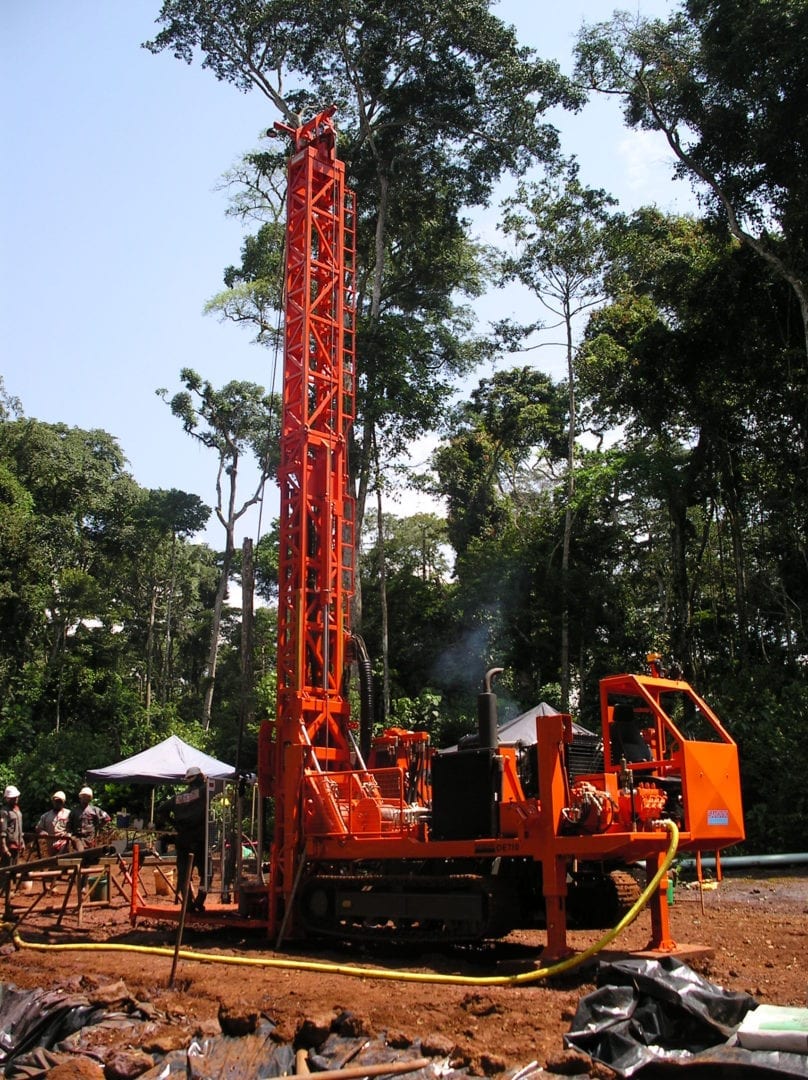
Exploration drilling forms an integral part of the mining value chain and is essential when validating and understanding the geology of potential new projects. Why then is the drill operator’s safety such a neglected area, asks Laura Cornish.
The local mining industry has become largely progressive over recent years and is devoting significant time and money on improved environmental practises, uplifting and supporting surrounding communities and, most importantly, on enhancing health and safety. “While working safely has become a key priority for the mining houses, drilling is one area where safety has been overlooked, often resulting in unnecessary accidents and serious injuries,” says Colin Rice, founder of Dicasa (the drilling industry certification authority of South Africa). Problems that have been identified include not understanding the dynamics of the drilling apparatus, how to use it and implement it properly, and respecting the machine. “This, however, is changing. In the past five years, mining and exploration houses have put increasing pressure on contracting companies to provide ‘proof’ that their staff are correctly and adequately trained to operate drilling equipment.” And Rice, through the Dicasa foundation, has every intention of fulfilling this industry requirement. Because no recognised driller certification and training programmes exist in the industry, Dicasa’s intention is to develop a certification framework for all drill operators, through to supervisory level. The intention is that this will ultimately become recognised and accepted as compulsory for drill operators across the entire mining industry. At present, all driller training in South Africa is done on an individual company basis. Many of the larger contracting companies have training facilities where their staff are trained on practical aspects of exploration and production drilling. In most cases, these facilities are used exclusively for in-house training. No independent drilling industry training facility exists and, as a consequence, no industry accepted competency standards exist. In an effort to address this situation, the National Diploma: Drilling Practice was designed and implemented in 1989 by the South African Drilling Association. Rice chaired the committee responsible for the design of the programme, the generation of course material and its implementation at what was then Technikon SA.The diploma was aimed specifically at qualifying supervisors and junior managers in the industry and to attract new entrants to the industry. For a number of reasons, interest in the qualification declined and it is no longer offered. Dicasa was formed to carry out the work Rice started implementing decades ago.
“The objectives of Dicasa are far wider than merely certifying that staff are competent to operate equipment. We believe that the upliftment of the industry is critical to our survival and development, and this is dependent upon making the industry an attractive one to be employed in. The driller and assistant drillers are a backbone of the industry and many have worked in the industry for many, many years, yet they have no recognition whatsoever, no defined career path and very little opportunity to move between specialisations. It is Dicasa’s primary objective to address this unacceptable situation.”
Is Dicasa making progress and reaching its objectives?
- diamond core drilling – surface, medium – hydraulic swivel-head
- diamond core drilling – surface, medium – longstroke
- diamond core drilling – surface, deep
- diamond core drilling – underground, electro hydraulic
- diamond core drilling – underground, pneumatic
- geotechnical investigations
- rotary drilling – blasthole
- percussion drilling – blasthole
- rotary percussion and dual tube reverse circulation drilling
- raisebore drilling.

