


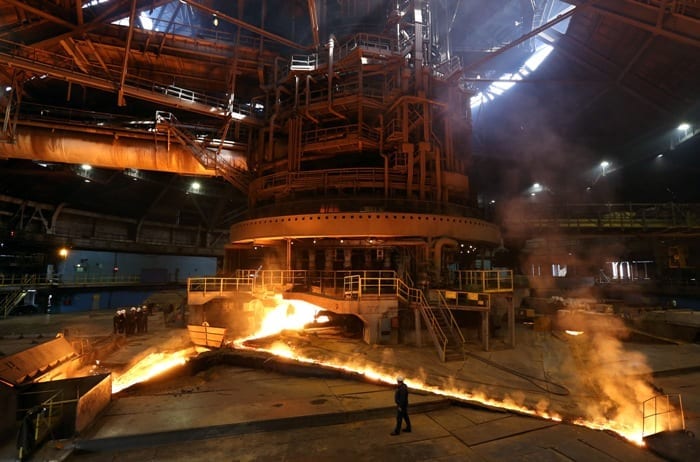
The market for local beneficiation of chromite ore at South Africa’s ferrochrome smelters has mushroomed recently, thanks to the volume required to make stainless steel (18%) and the country’s vast chromite reserves, the largest in the world. An Inside Mining exclusive.
Participating in this growth, Metix has emerged as one of the world experts in ferrochrome smelting technology, and the Southern African specialist for ferroalloy AC submerged arc furnaces. “Thanks to our merger with SMS Siemag at the end of 2011, we have also been able to combine our reference lists,” says Metix MD, Reinier Meyjes. “And while SMS Siemag has hundreds more references than us, if you look at the combined references for the past six years, a significant percentage is ours,” he adds. Metix marketing director,Pat Davies, and Meyjes started working together at chrome mining and ferroalloys producing Samancor back in 1974. “We built an 81-MVA ferromanganese furnace in Meyerton in 1978. At the time, the company intended to build several more, but only one was ever completed. Ferromanganese is used in most carbon steels in the 2% range. At the time, however, it seemed more cost-effective to export the ore for processing closer to overseas steel plants than to export ferromanganese,” Meyjes explains. More recently, Metix has started adding numerous new ferroalloy projects to its portfolio. The recently completed upgrading of International Ferro Metals’ two 66 MVA ferrochrome furnaces, which include new copper centre sections for the furnace roof, additional charging chutes equipped with solid copper feed chute tips and modifications to the four furnace gas cleaning plants. The uprating of the electrode columns on two existing furnaces at Xstrata Alloy’s Lion ferrochrome plant and the replacement of electrode columns on another two furnaces at Xstrata’s Wonderkop plant is another impressive feat for Metix.A 600 000 tpa chromite ore pelletising and sinter plant, part of the Tswelopele project being constructed for the Xstrata Merafe PSV in Rustenburg, is the sixth chromite pretreatment plant constructed by Metix since its formation in 2003. Globally, Metix technology and design engineering is the basis for the biggest silicomanganese furnace in China for mining and beneficiation company CYMCO, which is now in production in Jianshui. The 67.5 MVA furnace is equipped with the full range of Metix technology equipment: a set of electrodes; a furnace roof with a copper centre section; and a furnace shell with a freeze lining. Describing Metix’s modern furnace technology, Meyjes cites the recently completed IFM refit: “Energy efficiency has become more important than anything else in the furnace industry in recent times. By using less energy, you can produce more from a plant with a given installed capacity. This results in a double competitive advantage because by using less energy, the operating cost per tonnealsodecreasesproportionally,” he explains. And while improving energy efficiency is important, another key driver is to improve the availability of the plant. Downtime kills profitability and all furnaces need to be constantly running at near to their installed capacity in order to remain competitive. “Because the IFM furnaces were originally not one of our designs, the first thing we did to improve their efficiency was to improve the incoming feed of the furnace burden.” In ferroalloy furnaces, the feed material (burden) is fed into the furnace through charging chutes around the electrodes at the top. The ore is heated, melted and reduced as it moves downwards. Then the molten ferroalloy and slag are tapped off via tap holes. The smelting (reduction) process gives off very hot carbon monoxide (CO) gas, which rises up through the solid material of the burden. “Typically this gas is above 1 000°C, and by transferring as much of its sensible heat as possible to the burden entering the furnace, the smelting efficiency of the whole process benefits in two ways. Firstly, less electrical energy is required to smelt the hotter burden, and secondly, less energy is transferred to the water in the scrubbing plant,” Meyjes explains. Using 3D modelling for burden profiles and CFD for gas flow analysis,the shape of the burden surface andpotential for improvement of gas flow above the burden is studied. Through this process, Metix is able to determine the best arrangement and number of feed chutes into the furnace, even out the burden profile, maximise the recovery of sensible heat from the off-gas and reduce the temperature of the gas entering the scrubbing plant by several hundred degrees.In addition, because the roof is a fully enclosed design, the CO off-gas is not combusted in the furnace. After scrubbing, it can therefore be used to generate power. IFM has installed a cogeneration plant to make best use of the energy available from combusting this off-gas. It uses ten gas engines to recover a total of 11% of IFM’s power demand. “If you don’t use this gas, it would simply be vented to the atmosphere and flared after scrubbing, but every megawatt that you can feed back into the grid indirectly reduces the energy consumption of the furnace – “and the investment moves into cost-effective territory,” Meyjes suggests.
As an additional spin off, by reducing the temperature of the off-gas as it comes through the burden, the performance of the gas scrubbing plant is enhanced. Because of emissions legislation, producers are not allowed to run a furnace unless the gas is cleaned. “A shutdown in the gas scrubbing plant resultsin the furnace being shut down,” he continues. Metix has introduced an improved design to quench the off-gas leaving the furnace, “which allows the venturi system removing the particulate from the gas to become more effective.” Typically, in the venturi system, gas is accelerated through a narrow opening of the venturi where it is contacted with water. The energy in the venturi throat breaks up the water into small droplets about the same size as the solid particles in the gas, which reduces the surface tension of the individual droplets facilitating efficient capture of the small dust particles.If the temperature of furnace gas entering the venturi scrubber is too high, it evaporates the small water droplets (into steam), which then cannot capture small solids that form solid accretions in the duct following the venturi. The quencher’s role is to reduce the off-gas’ inlet temperature to enable the venturi to do its job properly. The duct between the quencher and the furnace is designed to be removed for easy, safe cleaning and ducts after the quencher are kept clean by continuous water sprays.” “Because IFM no longer has to regularly shut down its gas scrubbing plants to clean out dust build-up, furnace availability is significantly improved,” Meyjes says. The big development for ferrochrome and silicomanganese furnaces,however,involves closing the roof, and Metix’s use of copper, which improves the reliability of closed furnaces. “Almost all new furnaces are built with a closed roof, but we still have many that were previously built using a semi-closed roof design,” Meyjes advises. “These are ready for upgrading, but a rebuild takes time (up to three months), and the downtime cost is a killer for such projects,” he adds. For the ferrochrome sector, semi-closed furnaces have fallen out of favour due to the formation of toxic chromium-sixcompounds. There is no way to avoid the formation of these compoundsin a semi-closedfurnace. By converting a furnace to a fully closed design the benefit is two-fold –avoiding forming and dealing with chromium six and preventing burning CO in the furnace gas to CO2, which is ideal for cogeneration. Published performance improvements at IFM as a result of Metix’s recent upgrade to the company’s two 66 MVA ferrochrome furnaces show that by January of this year, the company had already achieved 12% of its target production cost savings. Also according to IFM reports:“The furnace rebuilds were all completed within budget and on schedule”. “Due to the remarkable success of Metix in the local market over the past eight years, SMS Siemag is fully comfortable with the current management and structure of Metix,” says SMS Siemag director for technical sales, Dr Rolf Degel. “The SMS Group has full confidence and trust in the capabilities of the Metix management team,” he concludes.
