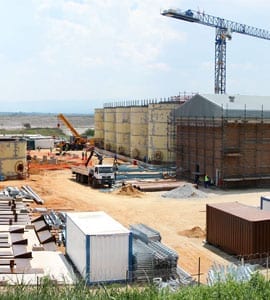
The construction of a new tertiary milling plant at the Steelpoort-based Two Rivers PGM mine is progressing rapidly and is set to come on stream towards the middle of this year.
It will offer significant value in terms of additional PGM recovery, making it an attractive project, writes Laura Cornish.
“The
tertiary milling plant’s (
TMP’s) sole purpose will be to retreat
secondary rougher tailings to recover
PGM material not recovered from the initial
Two Rivers metallurgical process plant,” explains
Ken Dyamond, projects director at
EPC project company
Basil Read Matomo.
Having completed a project feasibility study at the beginning of last year,
Basil Read Matomo was awarded the turnkey contract in March 2012 to design, build and commission the 250 000 tpm
TMP, which remains on schedule to be completed and commissioned mid-2013.
The Two Rivers mine is a joint venture between
African Rainbow Minerals (55%) and
Impala Platinum (45%). It is situated on the farm
Dwarsrivier on the southern part of the
Eastern Limb of the
Bushveld Igneous Complex. The mine delivers, on average, about 149 000 ozpa of platinum
.
“The plant will reprocess current arisings from the primary process plant, which will then be pumped via a tailings line through a tertiary milling circuit and flotation circuit, finally being returned to the main plant for further upgrade,” explains
Erik Bruggink, MD at
Basil Read Matomo.
African Rainbow Minerals’ business development manager,
Stompie Shiels says the project’s primary function is
PGM enhancement. “It will remove chrome and we expect a 1% recovery improvement overall,” he adds.
Despite having encountered one or two minor challenges on site, the impact on the project’s timeline has not altered. “We hit more under-surface rock than expected and as a result had to make various high adjustments to the terraces and to the foundations for the mill,”
Dyamond continues.
“Because of the flat
Basil Read Matomo management structure, and our general ‘can do’ attitude, challenges are quickly addressed and overcome, and in this particular case, with the hard work of the team under project manager Mark Wagner, we should bring the plant in ahead of the contractual completion date.”
To date, the majority of the civil works has been completed, with the installation of all major mechanical equipment having commenced in January this year. The majority of the major equipment is on site, which will facilitate a smooth erection process.
The peak construction phase will start in the second quarter of this year, with about 160 people on-site. Located adjacent to the main plant, the
TMP has been designed on a small, compact footprint and has been optimised in terms of power consumption, requiring only 3 MW to run at nameplate capacity.
The plant is designed to last between 20 and 30 years at its current size, which will not cater for future expansions. “It is designed for a specific purpose and will deliver on precise specifications. At
Basil Read Matomo we offer throughput guarantees, meaning our clients are assured their plants will deliver according to their exact needs provided the plants have the specified feed.”
TMP’s main contractors
Mill: New Concept Projects
Civils: M3 Construction
Spirals: Multotec and Metquip
SMP: DC Construction
Thickener: MIP Process Technologies (30 m diameter)
Pumps: First Africa Pumps
Committed to the community
Basil Read Matomo is well on its way to achieving its targeted Level 4 BEE status in the second quarter of 2013.
“Contributions to local community upliftment and
enterprise development have become key to our business going forward. In terms of enterprise development, we are ready to provide funding to a small local community project for the construction of an embankment,”
Dyamond notes.
Basil Read Matomo has been supporting a secondary school based in an informal settlement in
Daveyton for a number of years, including the equipping of a library. Other CSI projects include the supply of solar flood lighting in the
Eastern Cape with a second future project for lighting in the
Steelpoort area to be undertaken later this year.
“Our enterprise development programme was resurrected at the end of 2012 in the
Eastern Cape where a number of small
HDSA owned businesses (some of which are 100% women owned) have been identified which operate in the construction or engineering consulting business in the
Port Elizabeth area.” These businesses have been supplied with various equipment which ranged from a vehicle to computer equipment and software packages and will be followed up with mentoring and coaching in an effort to make these up and coming businesses sustainable.