


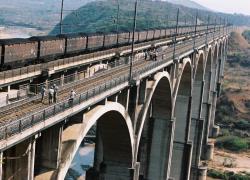
TFR is a world-class freight transport company, transporting bulk, break-bulk and containerised freight on approximately 20 500 km of railway.
Transnet Freight Rail (TFR), the largest operating division of Transnet SOC, maintains an extensive rail network across South Africa that connects with other rail networks in the sub- Saharan region, with its rail infrastructure representing about 80% of Africa’s total. The company is proud of its reputation for technological leadership beyond Africa as well as within Africa, where it is active in some 17 countries. TFR operates using a scheduled railway philosophy; this encompasses operating trains in accordance with an Integrated Train Plan (ITP) that is appropriately resourced to optimise capacity through careful deployment of assets to extract efficiencies. The aim is to significantly improve operational efficiency and customer service delivery with the help of the following six business units:- agriculture and bulk liquids
- coal
- container and automotive
- iron ore and manganese
- steel and cement
- mineral mining and chrome.
Due to the cost and time sensitivity of the SAC BU, one of its specific strategies is the development and implementation of a market development strategy focusing on collaboration with the industry, in order to grow the outbound less than train load sectors (accessRAIL) of the business.
Furthermore, it is important to develop innovative investment models in order to extract private sector capital. SAC is crucial to the economy of South Africa and cement is supplied to domestic markets and neighbouring markets such as Namibia, Swaziland, Botswana, Lesotho, Zimbabwe and Mozambique. The largest South African consumers of steel products are the manufacturing sector at 56%, the construction sector at 27% and the mining sector at 4%. TFR is continuously focusing on developing and upgrading infrastructure within the growing SAC industry. Mineral mining and chrome Mineral Mining and Chrome focuses on the transportation of magnetite flows from Phalaborwa to Richards Bay; Broodsnyersplaas in Mpumalanga; and Maputo, Mozambique. Rock phosphate moves from Phalaborwa to Richards Bay and chrome/ferrochrome from Rustenburg to Witbank and from Steelpoort to Richards Bay. Granite is transported from Rustenburg to Richards Bay. Coal The Coal BU focuses on the transportation of export and domestic coal by rail to various destinations, including Richards Bay, Vryheid, Ermelo, Ogies and Welgedag. Export coal is transported from Mpumalanga’s 44 rich mines and descends from the Highveld through rural KwaZulu-Natal and terminates at the Richards Bay Coal Terminal (RBCT). The 580 km long double line is bidirectionally signalled and fully electrified. Two 100 wagon trains are coupled to form one 200 wagon train at Ermelo, typically using CCL type wagons. Through the domestic coal sector, the Coal BU plays a vital role in the transportation of requisite amounts of coal to Eskom and other industries to generate electricity for the country. Furthermore, the unit is responsible for exporting sizeable amount of coal to generate billions in foreign exchange through the RBCT, Maputo ports, Navitrade, Transnet Port Terminal in Richards Bay and Bulk Connection in Durban. This unit’s commitment in transporting coal (South Africa’s ‘black gold’) is in line with the company’s long-term MDS and aids in the bid to shift rail-friendly freight traffic from road to rail. Iron ore and manganese This BU’s focus is on the export transportation of iron ore and manganese. It operates in the Saldanha, Sishen, Postmasburg, Kimberley and Port Elizabeth areas. Iron ore is transported from the mines in the Northern Cape to the Port of Saldanha. Manganese is transported from the mines in the Northern Cape to Port Elizabeth and Durban harbours. Manganese for domestic usage is transported to, among others, Meyerton, Fairview, Clewer, Nelspruit and Cato Ridge.
