


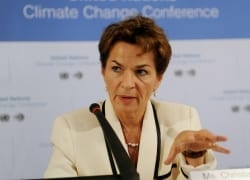
The head of the World Coal Association (WCA) has accused UN climate chief Christiana Figueres of “ignoring reality”, following her call to the coal industry to invest in more efficient technologies.
In an interview with Responding To Climate Change (RTCC), World Coal chief executive Milton Catelin told the organisation that Figueres’ lack of expertise in the mining and energy sectors meant she “misses some of the fundamentals about the energy sector”.
He was responding to a speech Figueres made to a ‘Climate and Coal Summit’ on the sidelines of UN negotiations in Warsaw two weeks ago, where she told the audience that “coal must change rapidly and dramatically for everyone’s sake.”
Figueres called for the closure of all low-efficiency subcritical plants, a roll-out of carbon capture and storage (CCS) technology and a collective decision to leave most coal reserves in the ground.
The UN climate chief was heavily criticised by green groups for attending the gathering, but her message does not seem to have gone down well with the coal investors and representatives inside.
Catelin equated Figueres’ call for the closure of older coal power stations to telling her home country of Costa Rica it could no longer have access to electricity.
“To suggest that you can close all subcritical [coal-fired] plants tomorrow totally ignores reality,” he said.
“She comes from a perspective where the only challenge in the world today is global warming,” he said.
“I think what we say is there’s more than one challenge – other things are almost as important or equally important, such as global poverty and the need to maintain economic development.”
State power utility Eskom will take Kriel power station off-line from 1 January next year, as it strives to comply with increasingly stringent environmental regulations, according to Business Report.
The emissions licences for Kriel, Matla and Duvha were revised by the Mpumalanga government in July 2013.
Taking Kriel off-line until the first unit at Medupi comes on-line will reduce the utility’s reserve capacity.
Eskom declared a power-supply emergency on 20 November 2013, reporting that the system was “severely constrained due to the loss of additional generating units from our power station fleet and the extensive use of emergency reserves.”

