


Both the mining and construction sectors have suffered losses in terms of contracts, which directly impacts on retrenchment of employees.
The mining sector saw a decrease of 13 000 employees (-2.5%) in September 2013, compared to the same period in September 2012.
To put this context, the construction sector saw an annual decrease of 9 000 employees for the period ending September 2013.
As companies consolidate their assets (human and physical), there is sometimes the temptation to cut corners to save money on occupational health and safety.
However, with the stringent regulations imposed by both the Department of Labour and the department of Mineral and Energy Affairs, any prudence in terms of required occupational health and safety (OHS) measures is ill-advised.
OSH EXPO Africa is now in its fourth year, and provides risk managers and health and safety professionals with Africa’s most comprehensive health and safety offerings in one venue.
The 2014 event is being hosted by UBM Montgomery at Gallagher Convention Centre in Midrand, Johannesburg from 13 to 15 May 2014.
“Often OHS and risk managers are unsure about the most suitable products for the application and may traditionally be limited by the advice provided by a limited number of suppliers.
“However, by accessing a wide variety of suppliers, with comprehensive product ranges, at a common venue, they are able to discuss the various options available to them. This allows them to ascertain best fit in each individual circumstance,” explains Joshua Low, event director at UBM Montgomery.
“In addition, the OSH EXPO Africa seminar programme provides visitors with a wealth of information about trends in the market, legislation pertaining to OHS matters and advice on implementing OHS programmes.
“We are currently compiling a list of subject matter as requested by industry, which will be presented by specialists in the OHS fields,” Low adds.
Keeping miners safe
The South African mining sector contributes over 18% towards the gross domestic product (GDP) of the country, making it a leading force in terms of both revenue and job creation.
The industry is characterised by rough and demanding work conditions and special attention is needed to ensure the health and safety of workers.
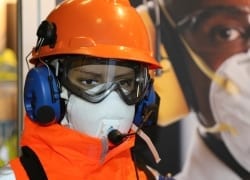
Reinforced boots, ear plugs, goggles or visors, hard wearing jackets and pants (some with padding), reflective vests, safety helmets and gloves form the staple of every miner’s personal protective equipment.
Other, more specialised equipment is utilised to determine chemical levels, noise levels, as well as the presence of fire and explosions. RFID tagging systems not only allow for tracking of employees and assets, but also alert mine vehicles to the presence of pedestrians to ensure high safety levels.
“Many of the OSH EXPO Africa exhibitors welcome interactive demonstration sessions on their stands. Visitors are invited to participate, allowing them to determine first-hand the benefits to be derived from the products being showcased.
“Other exhibitors offer a wide range of OHS risk assessment, programme compilation and management, as well as training services. These services can either replace or complement current mine OHS systems,” says Low.
OSH EXPO Africa 2014 will once again be co-located with IFSEC SA, the continent’s largest and most comprehensive fire and security technology and services exhibition of its kind.
The crossover from this exhibition, together with OSH EXPO Africa’s own unique visitor base, is fundamental in increasing exposure for exhibitors.
“With a tightening of budgets across the board, organisations are seeking ways in which to reduce operating and incidental costs.
“The technology, services and advice offered at OSH EXPO Africa 2014 will provide industry professionals with the opportunity to drastically reduce downtime and other related costs associated with accidents and fatalities on site.
“This, in turn, will lead to a positive organisational image and a healthier bottom line,” concludes Low.
Online registration for the exhibition is at www.oshexpoafrica.com.

