


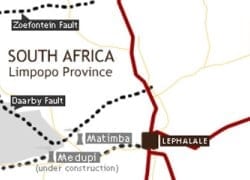
A new report on South Africa’s coal reserves, due for imminent release by the Council for Geosciences, is likely to intensify the debate on the strategic importance of the Waterberg coalfield, which has been hailed as the saviour of the country’s coal sector.
Exxaro’s greenfield Thabametsi mine in the Waterberg is expected to supply 17 million tonnes a year to Eskom, in addition to a further 2.8 million tonnes to other markets.
Meanwhile the 4 800 MW Coal Three power station, Eskom’s successor to the Medupi and Kusile, is widely touted to be located in the Waterberg.
However, the CFG report is likely to contain surprises on the exact extent of the country’s coal reserves.
Estimated coal reserves
Business Day’s Brendan Ryan obtained a copy of the research, which is believed to reveal that the Waterberg now accounts for 48.3 billion tonnes (72%) of the country’s total estimated coal reserves and resource of 66.6 billion tonnes as of November 2011.
This compares to 15.5 billion tonnes (28%) of a total estimate of 55.3 billion tonnes, estimated by JH Bredell in 1987, when the last assessment was carried out.
Over the same period, the quantity of coal contained in the Mpumalanga coal belt declined from 51% to only 19% of the total.
Latest CFG figures
However, the latest CFG figures are particularly significant in that they reveal that “those three fields still contain an estimated 12.4 billion tonnes of coal, considerably more than the 7.5 billion tonnes that the report estimates has been mined out since 1987,” said Ryan.
This raises the issue of the Waterberg’s strategic importance, as it is clear that there is a lot more coal in closer proximity to Eskom’s power stations than thought previously.
Infrastructure constraints
In addition, the undeveloped Waterberg has serious infrastructure constraints at present, while it is estimated it will cost R200 a tonne to rail coal from the Waterberg to Mpumalanga, once the requisite infrastructure is in place.
Another feather in Mpumalanga’s cap is that the three Mpumalanga coalfields comprise smaller blocks, ideal for junior miners, which is Eskom’s favoured business model for meeting its BBBEE obligations.

