


Researchers at MIT are working on a new process to replace platinum-group metals (PGMs) with more widely-available elements in renewable energy technologies.
The news comes in the wake of the global platinum sector facing a supply shortfall due to the protracted wage dispute in South Africa, which has hobbled production from the world’s top three platinum producers.
In a paper published last week in the journal Angewandte Chemie, the team explains their proposed new method for synthesising alternative catalysts.
Platinum, palladium, rhodium, iridium, ruthenium and osmium are the six least-abundant in the Earth’s lithosphere, yet are the most stable and active catalysts.
Efficient recycling
Even with efficient recycling, numerous studies have indicated that the earth simply does not contain enough PGMs to support a global renewable-energy economy.
Thus PGMs can be considered unsustainable resources that are currently needed to enable renewable energy technologies.
MIT team
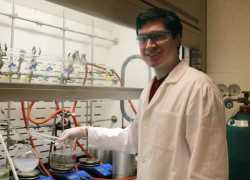
The team comprises MIT graduate student Sean Hunt, postdoctoral student Tarit Nimmandwudipong and Yuriy Román, an assistant professor of chemical engineering.
“Because the PGMs tend to be the most active and stable catalysts in virtually all relevant thermal and electrocatalytic processes, our research sought to answer an exciting question,” Hunt explains.
Modified electron density
“Rather than finding new materials to replace PGMs in specific reactions, is it possible to modify the electron density of earth-abundant early transition metals [groups IV to VI on the periodic table] to catalytically mimic the PGMs?”
In the simplest sense, one can imagine that tungsten, with six valence electrons, can be electronically modified to mimic platinum, which has 10 valence electrons, by reacting it with carbon (four valence electrons) to give the ceramic material tungsten carbide (WC).
Numerous studies
Numerous studies have shown that WC is indeed platinum-like, and able to catalyse important thermo- and electrocatalytic reactions that tungsten metal cannot — such as biomass conversion, hydrogen evolution, oxygen reduction and alcohol electrooxidation.
Importantly, tungsten is more than three orders of magnitude more abundant than platinum in the Earth’s crust, making it a viable material for a global renewable-energy economy.
Heterogeneous catalysts
However, both WC and platinum are heterogeneous catalysts, meaning that they require nanoparticle formulations to create high surface areas and invoke quantum confinement effects to maximize the rates of chemical reactions.
While platinum nanoparticles are relatively easy to synthesise, until now, there have been no known methods to synthesize WC nanoparticles less than 5 nanometers and devoid of surface impurities.
High temperatures
Tungsten carbide forms at very high temperatures, typically over 800 degrees Celsius. These high temperatures cause nanoparticles to sinter into large microparticles with low surface areas.
Methods to date that alleviate this agglomeration instead result in nanoparticles that are covered with excess surface carbon. These surface impurities greatly reduce, or completely eliminate, the catalytic activity of WC.
Removable ceramic coating method
To solve this problem, the MIT team developed a “removable ceramic coating method” by coating colloidally dispersed transition-metal oxide nanoparticles with microporous silica shells.
At high temperatures, they show that reactant gases, such as hydrogen and methane, are able to diffuse through these silica shells and intercalate into the encapsulated metal oxide nanoparticles.
This transforms the oxide nanoparticles into transition metal carbide (TMC) nanoparticles, while the silica shells prevent both sintering and excess carbon deposition.
The silica shells can then be easily removed at room temperature, allowing the dispersal of nonsintered, metal-terminated TMC nanoparticles onto any high-surface-area catalyst support.
This is the first method capable of this result.
Successful synthesis
The team has also been successful in synthesising the first non-sintered, metal-terminated bimetallic TMC nanoparticles.
Electrocatalytic studies have shown that these materials are able to perform hydrogen evolution and methanol electro-oxidation at rates similar to commercial PGM-based catalysts, while maintaining activity over thousands of cycles.
The catalytic activities obtained were more than two orders of magnitude better than commercial WC powders and WC nanoparticles made by current state-of-the-art synthesis methods that do not prevent sintering or surface carbon deposition.
Next steps
Next steps include the synthesis of other bimetallic TMCs, as well as transition metal nitride (TMN) nanoparticles.
The team is investigating these materials for other electrocatalytic reactions as well as thermal catalytic reactions, such as hydrodeoxygenation for biomass reforming.
“This new method unlocks a broad range of monometallic and heterometallic transition metal carbide and nitride nanoparticles that researchers previously have been unable to synthesise or study,” says Román.

