


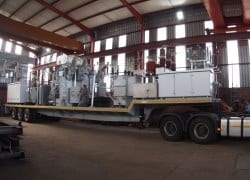
Zest Energy, a Zest WEG Group company, is poised to deliver the first of three mobile substations ordered by Eskom for deployment within its Mpumalanga Operating Unit. This represents the first mobile substation reference for Zest Energy in Africa.
Eskom will utilise the three new units — 40 MVA, 20 MVA and 10 MVA — during fixed-type substation refurbishments, maintenance and breakdowns as well as to improve the reliability of the grid network by limiting the duration of power interruptions. Mobile outdoor substation equipment The mobile outdoor substation equipment will be mounted and installed on custom-engineered trailers that comply with the South African road ordinance legislation in regard to weight and overall equipment dimensions. During transportation, the effects of trailer flex and movement on the integrity of the transformer design were also important considerations that had to be analysed. “Our parent organisation WEG has built this type of mobile substation for more than a decade and has supplied units extensively to South America,” says Coenraad Vrey, MD of Zest Energy. International references “We are drawing on WEG’s capabilities and experience for this order. WEG’s broad range of international references gave Eskom peace of mind that we were able to deliver a solution to suit their requirements.” In the planning stages of the contract, the design team consulted heavily with Eskom engineers to ensure that it gained a full understanding of the standard specifications and project engineering requirements. “Zest Energy is not an off-the-shelf solution company. Our custom-engineered solutions take into consideration all the various constants and customers’ preferred equipment specifications,” says Vrey. Compact design for local conditionsThe transformer is the specialist aspect of these Eskom units. Zest Energy, in consultation with Eskom and its WEG counterparts, has been able to come up with a very compact design specific to local conditions.
The Zest WEG Group has supplied power transformers to Eskom for several years already, but these are the first mobile substations the company has been asked to manufacture for the power utility. The technical and legislative requirements for these substations call for extensive engineering and testing to design a product that is compliant. Maximise local content The transformers for the mobile substations are imported from WEG in Brazil, while the substation switchgear is also imported from various international countries. However, all other substation components are being manufactured in South Africa, which is where the substations will also be assembled to promote maximum local content. Vrey comments that the concept of a purpose-built mobile substation is an ideal solution in this application, because the units can be utilised wherever needed within the region to save time, while providing the flexibility of being able to connect to several different high- and medium-voltage networks, especially when it comes to interfacing with Eskom’s older networks. Low impedances This is achieved by using multi-ratio transformers. The transformers were designed with very low impedances, capable of interfacing with Eskom’s current network infrastructure and limitations. Furthermore, the resulting designs were developed to be robust enough to withstand the internal forces that could be experienced during fault conditions. The contract makes provision for the training of Eskom drivers on the 20 MVA and the 40 MVA mobile substations, both of which have steerable axles for improved manoeuvrability.
