


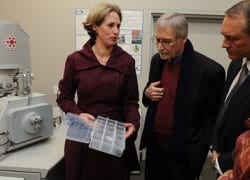
A new instrument acquired by UCT’s Centre for Minerals Research (CMR) is able to identify valuable minerals in ore of such low quality that it was previously deemed sub-economic.
As high-quality ore stocks become depleted, mining companies are forced to revisit those ores that had relatively small concentrations of the minerals they desired. Before the latest technology, analysing these samples was a laborious matter of poring through microscopes and recording data manually. Easy-to-process ores re running out “We know that these easy-to-process ores are running out. The mining industry will be forced to overcome a mineralogical barrier using innovative technology to unlock the value of rocks that are currently considered sub-economic,” said Dr Megan Becker, who heads up Process Mineralogy at UCT’s CMR. QEMSCAN (Quantitative Evaluation of Minerals by Scanning Electron Microscopy), is a R14 million instrument that provides detailed quantitative analysis of minerals, rocks, soils and man-made products, far more quickly than was previously possible.The key is a high-energy accelerating electron beam that scans the surface of an object and produces a colour-coded picture of the minerals it comprises.
Potential tool “You can see QEMSCAN as a potential tool to unlock process mineralogy of complex ores,” commented Dr Megan Becker, who heads process mineralogy at UCT’s CMR. It replaces the 14-year old LEO QEMSCAN that Anglo American Platinum donated to CMR in 2010, and which helped establish the centre’s mineralogical analysis capability. This older machine was traded in, allowing CMR to purchase the new version at roughly half the price.
