


As the licenced distributor of Siebtechnik centrifuges in southern Africa for over ten years, Multotec has access to a wide range of product available internationally.
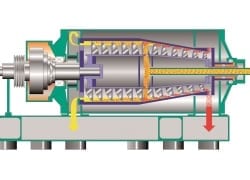
Filtration and sedimentation centrifuges Gerrit du Plessis, product specialist for Multotec’s Solid Liquid and Magnetic Separation Division, says that the range includes both filtration (pusher, vibrating and Conturbex) and sedimentation (conventional decanter) types of centrifuges, available for a multitude of applications. Apart from offering these two conventional types of centrifuges, Multotec can also offer the option of a collection of hybrid machines, which will include both sedimentation and filtration process steps. Siebtechnik centrifuges are manufactured under licence, or imported from Germany, depending on the type of machine required. The main differentiator with Siebtechnik centrifuges is that each is custom engineered for the application at hand. Solution customisation “Understanding customer needs and providing solution customisation to meet the specific operational parameters is a driving force for Multotec. In many instances, suppliers have a limited range, and they unfortunately force the available centrifuges to fit the application, instead of providing a fit for application purpose-made solution. “Having access to such a wide range of product data and designs makes the engineering of a centrifuge for a given application a viable proposition,” says Willem Slabbert, a process and application manager at Multotec. Continuously operating centrifuges have long established their place in the solid/liquid separation process. They can dewater large quantities of solids to low final moistures, while needing little space, energy and time. Installing the correct centrifuge By installing the correct centrifuge, organisations will reduce the cost of thermal drying considerably and may even make it superfluous. Siebtechnik specialises in the development and manufacture of continuously operating centrifuges, and supplies centrifuges across a broad range of industries, including mining. The decanter centrifuge provides separation by means of differences in specific gravity. Each design uses different techniques for separating the material and provides specific advantages, depending on the process requirements. Siebtechnik’s unique short-bowl decanters, with single-bearing overhang design, allow easy access for maintenance and cleaning purposes compared to conventional dual-bearing decanters. This feature also allows the machines to be used in high-temperature applications. where excessive thermal expansion can be better accommodated than dual bearing designs. Unique design of the twin-cone decanter The unique design of the twin-cone decanter can achieve the best of both worlds, with one machine producing a dry solid matter from its secondary drying cone and a clear centrate from the clarification bowl, while recirculating the centrate from the drying cone back to the feed.Conturbex was the first horizontal worm/screen centrifuge supplied by Siebtechnik in 1948. It quickly became a global name for separation technology and centrifuge construction principles, and has developed into a versatile screening centrifuge for a variety of separation requirements. Several thousand Siebtechnik Conturbex centrifuges are operating worldwide.
As with all Siebtechnik centrifuges, the rugged planetary gear unit, as well as all the anti-friction bearings, are connected to a circulating oil-lubrication system. All the components are generously dimensioned and will stand up to the most severe operating conditions. This ensures maximum service life with minimum maintenance. Conthick centrifuge The design of the Conthick centrifuge is based on the technology of Conturbex worm/screen centrifuge, with an additional pre-thickening unit for high-efficiency separation of low-solid concentration slurry, as well as a high recovery of fines. This centrifuge separates the solids from liquids in slurry. The slurry is fed via an inlet pipe to the pre-thickening part of the centrifuge via openings at the centre of the worm body. Both liquid streams can be discharged separately or jointly in one liquid stream through a double- or single-filtrate discharge cyclone, depending on the process requirements. A further development of the hybrid centrifuge range is the turbo screen decanter, which exposes solid matter to higher G-forces, while its increased surface area and larger-diameter screen facilitate longer washing. Siebtechnik’s new patented SHS/ZK pusher design provides operating, performance and cost benefits. The patented filling system consists of an accelerator cone and ring pocket, which ensures extremely gentle acceleration and uniform distribution of solids resulting in reduced abrasion in the feed zone. The ring pocket can be equipped with a screening element to provide pre-dewatering before the slurry reaches the screen basket. Longer conical screen This allows lower-than-normal feed concentrations to be introduced into the centrifuge. The wet end of the pusher features a longer conical screen, which ensures increased throughput capacity, greater washing efficiency and lower final moisture. The design features a combination of cylindrical or conical screening area, which results in improved capacity over common two-stage designs. Side-by-side tests have yielded up to 50% greater capacity and lower final moistures. “A special rotary transmission on the SHS/ZK Pusher allows the hydraulic mechanism to be isolated from the bearing area. The improved hydraulics results in lower maintenance, easier access and reduced downtime. Also, this design eliminates high-pressure hydraulic oil at the main shaft seal, which prevents oil leakage into the processing area via the pusher shaft, allowing additional room for positive and dependable process seal designs at the hollow shaft,” explains du Plessis. He adds that the continuously-adjustable stroke length of the SHS/ZK is accessible from outside the unit. In addition, stroke reversal is operated electrically, and does not depend upon pressure. Both single- and multi-stage pusher designs are available. Single-stage machines Single-stage machines are more sensitive to fluctuations in quantity and solids concentration of the feed. The two-stage centrifuges are the preferred choice over more complicated three and four-stage designs. “These two-stage pushers offer high throughputs, combined with great reliability and flexibility. They often process larger quantities than four-stage machines, while concurrently being less expensive, less complicated, and producing substantial process advantages,” says du Plessis. Additional special design features include gas-tight configurations to ensure a safe environment in toxic and flammable process applications, an internal re-pulping system to eliminate inter-stage re-pulping equipment and specially-designed food-application machines. “We realise that, for optimum performance, the solution needs to be customised to suit the specific application need. Our engineers have amassed years of experience in assessing countless numbers of challenges and solutions, and are able to apply this technical and practical knowledge to ensure the product matches the demands of the application,” concludes Slabbert.
