Uranex announced that it has made good progress on the resource drilling program at its Tanzania-based Nachu graphite project – also noting that ‘significant’ graphite intercepts continue.
To date, 55 drill holes have been completed for a total of 6 480 meters drilled.
Uranex said that the 2014 exploration drilling program has made significant progress and defined target areas for initial resource studies.
Multiple graphite zones
The vast size and potential of the Nachu Graphite Project has meant Uranex has the enviable task of choosing from multiple extensive graphite zones.
“Despite a slow start to our drilling campaign, we have recovered really well and we are seeing some exciting results,” commented Uranex CEO Rod Chittenden.
“Today’s announcement highlights our longest continuous intercepts of graphite. With mineralisation beginning at or near surface Nachu is showing all the signs of a world class deposit. We look forward to further observations and assays in the coming weeks as we work towards our maiden JORC resource,” said Chittenden.
Rapid drilling phase
The initial rapid drilling phase for exploration and resource purposes is on track to be completed by the end of August using the three drill rigs that are currently operating including two air rigs drilling RC and a core drilling rig.
The drill samples are being prepared and analysed for resource quality and metallurgical study data including the preparation of bulk samples to supply end users.
The objective of the current drilling phase, which commenced in July, is to declare Uranex’s maiden JORC resource by November 2014, reports Uranex.
Drilling intercept highlights
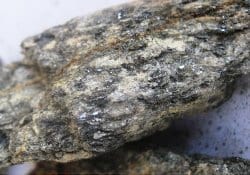
Drilling has confirmed graphitic schist and potential mineralisation is present in multiple horizons throughout the Nachu Graphite Project.
The 36 drill holes completed since 5 August 2014 were designed to intersect the potential mineralised horizons as close to perpendicular as possible based on geophysical electro-magnetic (EM) response modelling, reports Uranex.
Full structural interpretation and modelling will use multiple drill hole intersects and evaluation of structural orientations measured, states the company.