


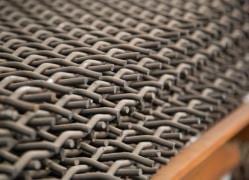
Screening and vibrating equipment solutions supplier Aury Africa invested R1 million to manufacture woven wire screens, enabling the company to meets its production targets efficiently.
The company announced on Wednesday that it is on track to meets its production target of 1 000 units per month, just weeks after officially beginning the local manufacture of its woven wire screens.Meeting targets
“We are extremely satisfied with the progression that we have made in terms of local production, and are on track towards meeting our target of 1 000 screens per month,” says Aury Africa MD Mark Houchin. The 5 000 m2 facility in Jet Park, Boksburg, features a large loom for weaving wires larger than 5 mm, and a small loom for weaving wires below 5 mm. Houchin explains that the large loom is capable of manufacturing screens up to 3 m wide and 20 m long, while the small loom has the capacity to manufacture screens up to 2 m in width and 10 m in length, with all screens cut to size after production. Both looms run on an around-the-clock basis in order to meet production targets and growing demand from clients operating predominantly in the plants and quarries sectors.Creating employment
Aury Africa has also created six new full-time operational positions by localising production.As a result, the company’s staff complement has risen from 36 to 42 employees, as a permanent night shift has been established in order to keep up with rising demand from across Africa, reports the company.
Houchin says that local production has dramatically improved turnaround times too. “Importing the woven wire screens from our China-based sister company, Aury Tianjin typically resulted in a three month turnaround time for clients. Since we started local production, this lead time has been reduced to around two weeks, which is a major value-add for our customer base.”
