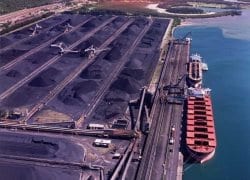
South Africa’s coal exports has been partially displaced by low-cost coal from Australia as well as several stoppages at the Richards Bay Coal Terminal (RBCT).
This is according to Australia’s Bureau of Resources and Energy Economics, a statistical research unit within Australia’s Department of Industry, which states that South Africa’s coal exports in 2014 are forecast to increase by 1.7% to 73 million tonnes.
The report states that China, where much of South Africa’s coal exports are destined, will continue to be a major driver of global economic growth, albeit at a slower pace than in previous years.
Rail infrastructure
“While RBCT has a capacity of 91 million tonnes, exports have never approached this volume because rail infrastructure has struggled to operate consistently,” stated the report.
South Africa’s rail capacity is planned to be upgraded, but this is not expected to have a material effect on exports until toward the end of the projection period, according to the Australian Bureau.
The Bureau projects an increase in exports from South Africa at an average annual rate of 3.6% to 87 million tonnes in 2019.
The global economy is forecast to grow by 3.5% cent in 2014, driven by continued growth in emerging economies and improved conditions in the United States.
Global outlook
“While the outlook is generally positive, there are a number of risks to global economic growth prospects over the short to medium term,” stated the report.
These include China’s ability to maintain economic momentum while transitioning to a pattern of lower, more sustainable growth.
“The successful implementation of China’s reform agenda to achieve these goals will be a key risk to both China’s economic prospects and that of its major trading partners,” noted the report.
Electricity demand and consumption
In 2012, the Organisation for Economic Cooperation and Development (OECD) accounted for 49% of world electricity consumption, but only 17% of the world’s population.
Closing the gap in electricity consumption rates may be one of the challenges that defines the 21st century. Further investment in new electricity generation capacity will be required to meet growing electricity consumption, stated the Bureau.
SA’s R111bn nuclear deal
As far as South Africa’s electricity generation capacity, this week Russia’s Rosatom nuclear company announced a R111 billion nuclear energy deal with South Africa to develop eight nuclear power stations in the country.
This would partially offset South Africa’s current dependence on coal-fired power stations that accounts for 80% of electricity generated in the country.
“The agreement lays the foundation for the large-scale nuclear power plants procurement and development programme of South Africa … [which would include] new nuclear power plants with Russian VVER reactors with total installed capacity of up to 9.6 gigawatts [up to eight … units],” South Africa Department of Energy said on Monday in a statement.
South Africa’s Integrated Resource Plan 2010 makes provision for 9.6 gigawatts of nuclear power, with that capacity expected to come online by 2030.
Emerging economies
Emerging economies are forecast to grow by 4.6% in 2014 and the OECD by 2.0%, according to the Bureau’s report.
Over the medium term, world economic growth is assumed to rise to 4.0%, with growth in emerging and OECD economies increasing to 5.3% and 2.6%, respectively.
According to the report, a key question emerging for the 21st century is what happens when developing economies start to catch up to the living standards of the OECD, made up of the leading economies of the world.