


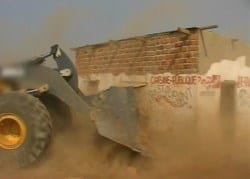
Amnesty International on Monday accused a Belgian mining giant of trying to cover up its role in the bulldozing of hundreds of homes around one of its mines in the Democratic Republic of Congo.
The non-governmental human rights organisation says Belgian miner Groupe Forrest International has consistently lied about displacing communities and has denied justice to those affected, said Amnesty in a report on Monday.Unlawful demolition
Amnesty International’s report indicates that satellite imagery has exposed the company’s subsidiary, Entreprise Général Malta Forrest’s (EGMFs) supply of bulldozers that were used to unlawfully demolish homes and forcibly evict hundreds of people living next to the company’s Luiswishi mine in Kawama, Katanga in 2009. It also details how the companies and the Congolese government have obstructed attempts to achieve justice for the villagers ever since. “There is now overwhelming and irrefutable evidence showing that the forced evictions that Groupe Forrest International has denied for years in fact took place,” said Audrey Gaughran, Amnesty Internationals’ Global Issues Director.Forcible eviction
Amnesty said it had obtained the satellite images along with other evidence that proved Forrest International may have helped with the forcible eviction of hundreds of people in Kawama. According to Amnesty, Groupe Forrest denies all involvement in the operation carried out by Congolese police in November 2009, which cleared hundreds of small-scale miners who they accused of stealing from the huge copper and cobalt mine at Kawama. Amnesty claims bulldozers from EGMF were used to clear the village, not far from Lubumbashi, the second biggest city in the province, the country’s economic motor. “It is shameful for a mining giant to lie and deny people justice. It is time for them to finally come clean and compensate the villagers for what they lost,” said Gaughran.Five years on, the villagers of Kawama have received no compensation, stated Amnesty.

