


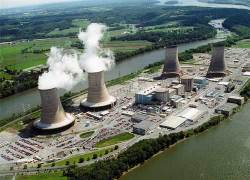
Nuclear energy has a role to play in the electrification of Africa, with sub-Saharan Africa increasingly showing an interest in developing a capacity for nuclear power generation.
According to the World Nuclear Association, countries actively considering nuclear power programs include Nigeria, Ghana, Senegal, Namibia, Sudan, Uganda and Namibia, while countries already developing plans include Nigeria and Kenya. According to the International Energy Agency, while Namibia gets half its electric power from South Africa, it also holds about 8.2% of the world’s uranium reserves mined from two sites to fuel nuclear power stations around the world. For this reason, Namibia’s government has committed to a goal of supplying its own electricity from nuclear power.South Africa’s nuclear agenda
South Africa has started seriously shopping around for companies to build eight new nuclear power plants totalling up to 9 600 megawatts by 2030 as part of an estimated $37 billion nuclear expansion program. The South African prematurely and perhaps controversially announced a nuclear deal with Russian company Rosatom that was said to be worth $111 billion for the build of eight nuclear plants. Russia’s atomic energy in September said it would provide eight nuclear reactors to South Africa by 2023 in a strategic partnership between the two countries.Nuclear challenges
South Africa’s nuclear energy agreement with Russian was met with public outcry; much owing to the perceived challenges and risks that nuclear power would pose in the country. The International Energy Agency’s ‘Africa Energy Outlook’ released in October states that “the introduction of nuclear power brings many challenges, not least of which is the very large upfront capital investment required, the need to develop technical and regulatory capacity, and to have the electricity demand and infrastructure capacity to absorb the resulting baseload supply.” Because population areas are growing significantly, those countries “need a safe, secure and most importantly, clean source of electricity, so they’re interested in nuclear,” Nuclear Energy Institute’s Executive Director, Policy Development and Supplier Programs, Daniel S. Lipman, told AFKInsider.US Africa Leaders’ Summit
The US-based Nuclear Energy Institute hosted a delegation of African leaders from Niger, Namibia and South Africa to discuss nuclear energy development during an U.S.-Africa Leaders’ Summit in August.A big takeaway at the Nuclear Energy Institute meeting, Lipman says was that “there might be places in western Africa where a plant can serve one, two or three different countries.”
“In other words, there are borders that lend themselves to building grids that connect population sectors across different borders,” Lipman told AFKInsider. “And when you do that, grid stability; grid size; grid location – they allow for citing of nuclear plants not just in a particular country, but for where different countries share in the nuclear plant,” says Lipman.
