


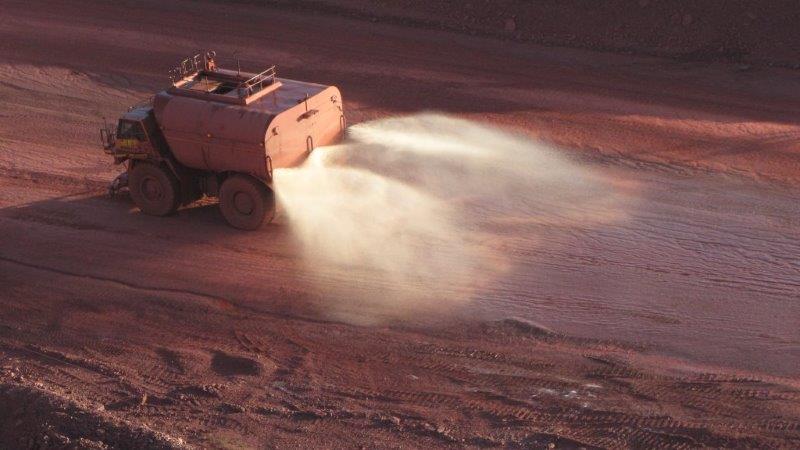
In addition to being in short supply, water is also severely limited in its effectiveness, as it evaporates quickly – thereby releasing the dust back into the environment. In order to address this challenge I-CAT Environmental Solutions stocks and distributes the internationally-recognised Telesto SCRUBmist dry mist dust suppression system.
What it doesI-CAT operations director Anton van der Merwe notes that the dry mist system removes respirable and inhalable dust particles from the air with minimal water usage, and no collateral damage to property. “It works by atomising water into minute droplets 5 micron (µm) to 15 µm in size. They are electrostatically attracted to dust particles and form agglomerations that subsequently fall out of the air.” Conventional sprinkler systems produce considerably larger droplets of between 80 µm and 100 µm. These collide with far less particles, as the air-stream present around them deflects dust outwards and away. Wind and high temperatures are also factors that negatively impact the dispersal of droplets produced by conventional systems, which have low kinetic energy and are easily neutralised. By injecting water between layers of air moving at supersonic speed, van der Merwe explains that the dry mist system is able to produce droplets with high kinetic energy that remain unaffected in the harshest conditions. “As a result, SCRUBmist utilises as little as 200 ml per minute, compared to sprinkler systems that spray multiple litres of water per nozzle per minute.” With this technology, the water volume per nozzle can be adjusted and only two nozzles are required per installation point, as opposed to the standard of 20 or more. This not only saves resources, but also lowers operational costs. The SCRUBmist system is ideally-suited for use in a variety of applications, including; coal mines, power plants, wood and stone aggregate plants, and cement factories.
Van der Merwe adds: “The use of this system guarantees safety, improves working conditions and increases productivity, while simultaneously minimising downtime by lowering machinery repair and replacement costs.”
The success of SCRUBmist has already been proven at Nkomati Nickel Mine in Mpumalanga, where the system was installed at 19 transfer points. “The project was completed in August 2014, following two months of installation work and the system continues to run smoothly to date,” reveals van der Merwe. I-CAT is currently installing a SCRUBmist system at Assmang’s Beeshoek Iron Ore Mine in the Northern Cape too. “The project also includes the installation of a programming logic controller (PLC) for remote system automation and monitoring, and is due for completion in April 2015,” van der Merwe concludes.
