


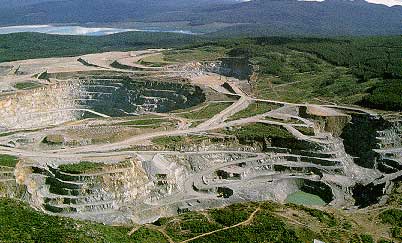
The Centre for Environmental Rights hosted a seminar on Mine Closure and Rehabilitation, entitled “From Dereliction to Accountability?”, in Johannesburg on 5 May 2016.
Director of the Centre for Sustainability in Mining and Industry at the University of the Witwatersrand Prof Caroline Digby told the audience that she saw a deep resistance in the mining industry, and in government, to talking about mine closure – no-one really wants to close a mine or see any mine closed today. Prof Digby shared findings of an international comparative assessment on mine closure undertaken in 10 jurisdictions, including South Africa, various U.S. states and various Australian states. This review showed that, internationally, regulators are starting to pay far more attention to closure and rehabilitation, partly because the economic cycle is seeing more unplanned closure, and partly because there is now far greater public awareness around these issues. It has only been in the last 15-20 years that regulators have been looking at closure – before that, mines simply “locked the gate” and walked away, leaving us with many of the legacy issues we deal with today. Some of the challenges revealed by the international comparison included the fact that different cost models produce widely different estimates of closure costs, emphasising the need for a standard approach to the calculation of adequate financial provision for rehabilitation. Moreover, there are very few examples of successfully relinquished or closed mines, and this in itself requires scrutiny. Prof Digby emphasised that, internationally, mine closure has largely focused on environmental impacts, while very little progress has been made in dealing with the social impacts of mine closure – in her view, despite the challenges here, South Africa was actually further advanced in thinking about this than most countries.Dee Fischer, Chief Director: Integrated Environmental Management, Department of Environmental Affairs (DEA), was responsible for the development of the new Regulations pertaining to Financial Provision for Prospecting, Exploration, Mining or Production Operations published under NEMA in 2015. She explained how the One Environmental System, with mining now regulated under environmental laws, required a new regulatory approach to mine closure.
The new regulations take a much broader view of the lifecycle of the mine, including annual rehabilitation, rehabilitation at closure at the end of life of mine, and rehabilitation of latent or residual impacts that may arise long after mining has ended. The regulations are more specific about the accurate calculation of financial provision, and importantly now require mines at any time to have funds available to pay for rehabilitation costs within a 10 year timeframe (mining companies traditionally hold far less funds in trust for rehabilitation). The regulations also require involvement of more independent specialists, regular review and audits, and publication of financial provision and audits on mining companies’ websites. Financial provision must also be signed off by the Chief Executive Officer of the mining company to ensure accountability at the highest level. Fischer acknowledged that there was resistance from the mining industry to the new regulations, particularly the tax implications of some of the new rules. She indicated a willingness on behalf of the DEA to hear criticism from mining houses and civil society stakeholders with a view to clarifying and improving the regulations.
