


 The Kusile Power Station, a new high-efficiency, reduced-emissions coal-fired power plant, east of Pretoria will provide electricity to 3 million South African homes when it is up and running.
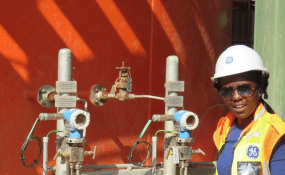
At the helm of its operations is project director for GE Steam Power Systems, Nthabiseng Kubheka, who runs the construction of a critical piece of the power plant.
Kubheka will lead the engineering, procurement and construction (EPC) of Kusile’s unique desulphurization plant — the first of its kind in Africa and the star of the project — and to make sure all processes perform as planned.
Known as the Wet Flue Gas Desulphurization Plant, it sends flue gas through scrubbers, which transform sulfur dioxide from a harmful gas into a synthetic form of the mineral gypsum, by spraying limestone slurry into the flue gas.
Mist eliminators then remove the moisture from the treated flue gas before it’s released into the environment as water vapour. The leftover gypsum can be recycled and moved to a landfill or sold.
The plant, which is still under construction, will include six GE 800 megawatt steam turbines, a generator, an air-cooled condenser and all the necessary piping and auxiliaries.
The plant has a supercritical boiler and turbine set, meaning that it has higher steam pressures and temperatures. In addition, the plant uses a fraction of the water used by many other plants, thanks to the use of air-cooled condensers instead of a wet-cooled power plant.
Kubheka began her career 20 years ago, as a chemist analysing raw materials for industrial companies. “Because my job involved toxins, I was moved from the lab into quality control,” says Kubheka.
She worked at South African power utility Eskom, GE’s partner in the Kusile project, and after just 10 months, she was spotted as a key talent and put through the utility’s Technical Managers Leadership program.
The program earned her a place on a team that refurbished an old South African power plant called Komati Power Station, her first experience in project management. By the time she left Eskom and joined GE in 2016, she was heading a portfolio of similar projects involving coal fired plants in South Africa.
Kubheka says her job has given her the chance to prove herself, and has earned her the respect of her male colleagues.
South Africa has 16 coal-fired plants, 12 of which are in the Mpumalanga province — the country’s coal capital. South Africa has abundant coal reserves, so the key to the future of coal-fired power plants lies in making these plants as clean as possible.

