


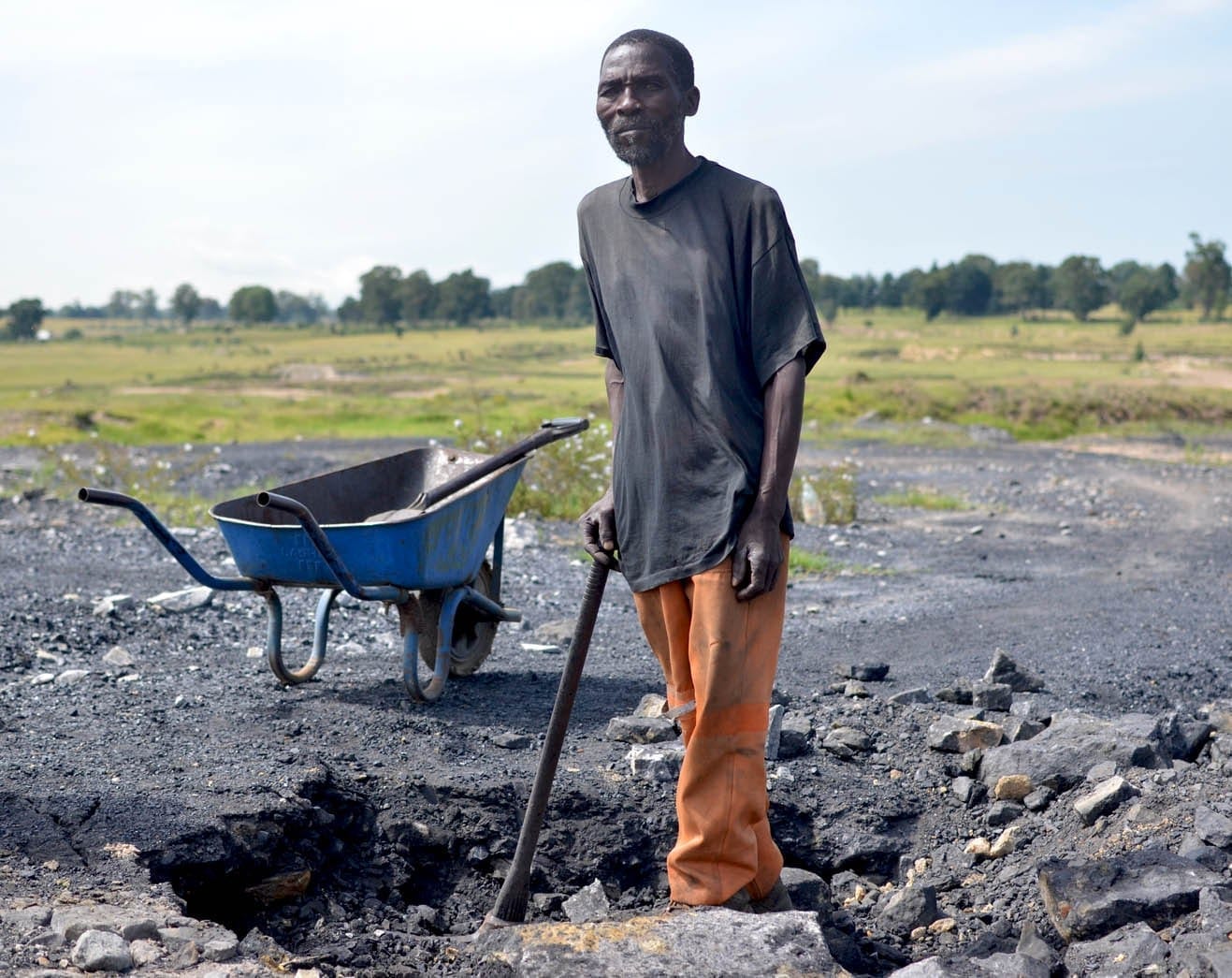
An artisanal miner digs coal at an abandoned mine in the Wesselton township in Ermelo, Mpumalanga. Photos: Mark Olalde
On the West Rand, Mintails Mining South Africa holds three mining rights, which cover 1 715ha near Krugersdorp and operate in business rescue. The business rescue plan shows that Mintails requires about R259 million to complete rehabilitation on those rights – a figure that is far too low, according to the environmental management programme report. The PAIA documents reveal that the company and related entities hold less than R17 million in funds for rehabilitation.
Financial provisions According to Department of Environmental Affairs (DEA) statistics obtained by Oxpeckers, 40% of operational mines held inadequate financial provisions in 2012/13. This insufficient provisioning was in part due to the fact that the guidelines for calculating financial provisions have not been updated in more than 12 years. Exacerbating the problem, legislation does not allow funds to be used for concurrent rehabilitation. The information from the environment department also sheds light on the confusion and lack of oversight involved with the granting of closure certificates. The department was told 575 applications for closure certificates were under consideration and 159 were issued in 2013/14 – however, according to answers the Department of Mineral Resources (DMR) provided in Parliament in response to questions from the Democratic Alliance, only 102 were issued that year. The Western Cape and North West were the only DMR offices that failed to provide information in response to the Oxpeckers’ PAIA requests by the time of publication. The Mpumalanga and Limpopo offices handed over information relating to closure certificates, but they indicated a refusal to include information regarding financial provisions – in contravention of the national office’s legally binding decision to grant the requests. The Northern Cape’s Springbok regional office provided a list of all closure certificate applications and all granted certificates since the Mineral and Petroleum Resources Development Act took effect in May 2004. Those records highlight the learning curve associated with new legislation. Between 2004 and 2008, companies applied for closure at only 13 sites. A total of 184 mines applied for closure in Northern Cape’s Springbok region since the implementation of the minerals act, and 124 were issued closure certificates. An official from the Springbok office told Oxpeckers that the DMR must wait for the Department of Water and Sanitation’s comments on closure applications before granting certificates, a process that is often slow. Evolving legislation Laws governing environmental management of the mining industry are shifting with the advent of the One Environmental System (OES) in December 2014. The new system was created with the goal of streamlining environment regulations by bringing together the DMR, the DEA and the Department of Water and Sanitation. Marthán Theart, an attorney at the Centre for Environmental Rights, has been closely following the evolution of the hotly debated financial provision regulations, an integral aspect of the new OES system. “The new financial provision regulations provide for a fund that is big enough to cover three types of rehabilitation: annual rehabilitation and remediation, the decommissioning of a mine, and latent or residual impacts of a mine – in other words, the risk of acid mine drainage,” Theart said. In an imminent round of amendments to the provisions, the DEA plans to roll back its inclusion of “care and maintenance” oversight – a term the industry created to explain indefinitely mothballing unproductive mines – due to a belief held in the department that this oversight oversteps its mandate. The department is also considering removing the requirement that prospecting rights hold financial provisions. In a statement sent to Oxpeckers, DEA spokesperson Albi Modise said, “Legislation and its implementation is generally an iterative process and therefore the system had to be tweaked to ensure that smoother operation was achieved.” The National Water Act is also in need of updating, as aspects of the recently published amendments to the water use licensing process remain “very vague”, Theart said. The Department of Water and Sanitation did not respond to repeated requests for comment on its role in the OES. The DMR only addressed some of the questions Oxpeckers sent for this story and did not comment on the implementation of the OES. Modise said further amendments were necessary to comply with the Income Tax Act, to remove “restrictions on the use of trust funds” – another type of financial provision – and to provide “guidance on the manner of calculating the sum required to be set aside for financial provisions”. In the meantime, it is unclear which laws apply. “The transition is not going very smoothly,” Theart said. “There is a big gap, and I think that gap is probably going to be filled by just applying the old regulations of the Mineral and Petroleum Resources Development Act that haven’t been repealed.” In response to the OES regulations on financial provisions, members of the mining industry, including DRDGOLD and Sibanye Gold Limited, launched litigation in late 2016 against the three relevant government departments and others. The court application – which Theart called “gun to the head litigation” – seeks to clarify aspects of the regulations, including how mine closure trust funds can be used, the tax implications of transferring funds among different types of financial provisions and clarifying environmental liability. Tracy-Lynn Humby, a law professor at the University of the Witwatersrand and an expert on the legislation governing mining, said it is still too early to determine whether the OES will be a success, as the legislation needs to be fine-tuned. “The DEA had a lot of pushback from industry. This is the single environmental system being tested,” Humby said. “Is this really a more sustainable solution or is this simply business as usual but with a green veil?” – Oxpeckers.org
