


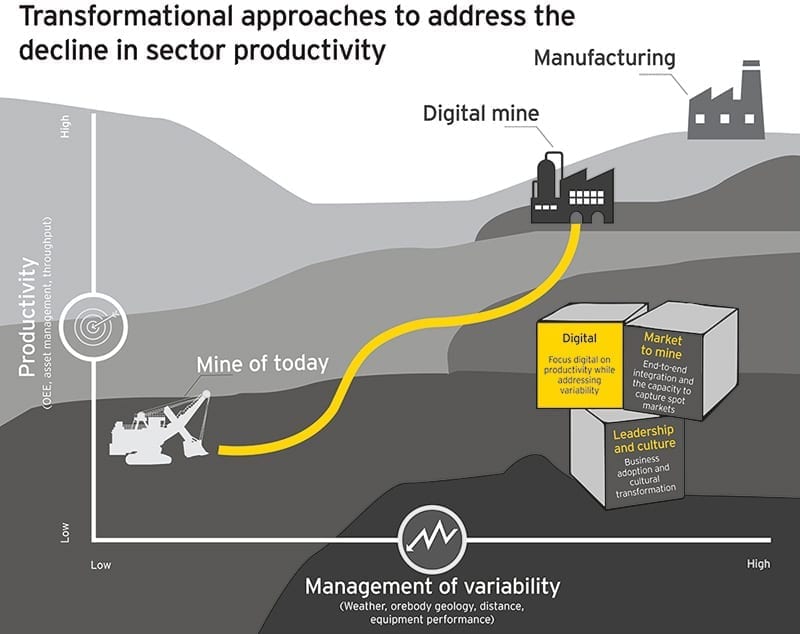
“Addressing the digital disconnect will be critical to succeed in the rapidly changing digital world. The digital disconnect exists, not because of a lack of engagement from the sector, but because of a range of practical issues that continue to challenge the industry,” added EY.
The company’s report expanded on the potential benefits of digital to help exploit the number one operational opportunity in mining – productivity – and detailed the common pitfalls. “Understanding these pitfalls will help answer the question, ‘With so much opportunity, why is the road to digital transformation littered with stalled or failed endeavours?’, the company said. No matter where clients are on the digital journey, EY’s holistic approach can help mining companies navigate digital disruption by taking not of these pitfalls that drive disconnect between digital transformation and mining. Eight common pitfalls driving this disconnect- Lack of detail on the implementation pathway – The is a consensus on a digital vision, but little discussion on how to move from the current state to this vision.
- Perception of high costs – The perception that projects linked to IR systems often over-promise and under-deliver can delay decisions to commence a digital imitative
- Unclear accountability and a disconnect with the current operating model – Owners of digital transformation are often unclear and silos within the operation are mismatched with a fundamentally different way of operating.
- Ill-defined business model and business case – Scepticism remains from leadership as tot eh robustness of the business case for digital and heat the new business model will look like
- Lack of digital education and understanding – This can result in an aversion to change or a rush to implement something through a desire to appear progressive
- Remote decision-making crates dissonance with local leadership – Issues that arise: cultural difficulties of new remote operation models, a reluctance to concede leadership to external teams and understanding resources and data requirement
- Data systems lack maturing to support the future vision – A key disconnect with the vision of the digital future is the quality of data available for decisions making which can be inconsistent.
- Systems and process already in place are not being optimised – Significant digital footprints are often already in place and leaders must understand why this is not fully utilised before implanting new approaches

