


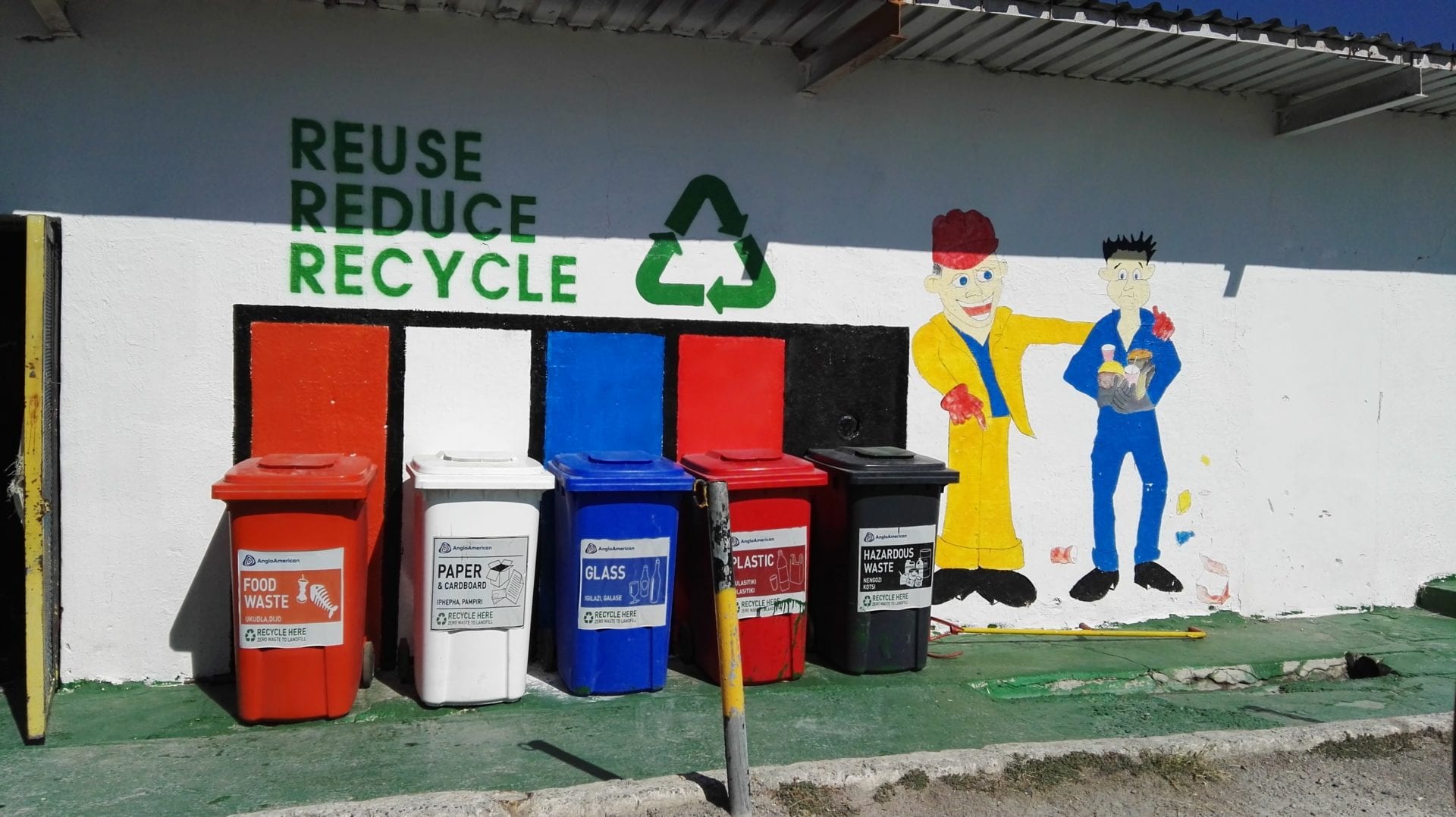
Anglo American Platinum’s CEO Chris Griffith said that the company was on track to meet its target of sending zero waste to landfill by the end of 2020, with a 45% decline reported in the year-to-date compared with the same period in 2018.
The company said that at the current year-to-date performance, the full year forecast for total waste to landfill will be an estimated 3,770 tonnes, a 52% reduction from 2018’s 7,899 tonnes. In 2013, when the target was set initially, and the company’s operational footprint was bigger, waste to landfill was at more than 22,000 tonnes. The target to eliminate waste to landfill is in support of Anglo American’s broader environmental strategy, which includes reducing water and energy usage, lowering emissions, dust and noise pollution, and implementing biodiversity stewardship programmes. In August 2018, a specialist waste company Interwaste was appointed to assist with the development of zero waster to landfill (ZW2L) strategy to support with solutions that will allow for zero waste to landfill by the end of 2020. Griffith said that with the world’s population expected to reach 10 billion by 2050, we cannot continue to consume resources at the same rate. “Back in 2013, our ZW2L approach was developed to not only ensure that our children inherit a sustainable future, but for the direct benefit of our health and the natural environment, and to ensure compliance with environmental regulations. All of this has the added benefit of cost savings for our company,” he added. The company said that by treating waste as a resource rather than merely sending it to landfill, various revenue-generating and cost-saving opportunities have been unlocked. The reduction in waste can for example remove the need to build new landfills at Anglo American Platinum’s Mogalakwena Mine in Limpopo and Unki Mine in Zimbabwe. On-site bioremediation facilities, off-takes for gypsum and sodium chloride as well as selling scrap metal, sodium sulphate and used oil, has also generated additional revenue at some of the operations. Hermanus Prinsloo, Lead Environment – Operations (Platinum) at Anglo American said that landfills are not a sustainable way to manage waste, as they harm the environment and are costly to develop, maintain and ultimately remediate. “However, transitioning to a zero-waste system does not happen overnight. It has required a fundamental mind shift change to see waste as a valuable commodity, encouraging investment, creativity and innovative solutions,” Prinsloo added.To eliminate waste to landfill, the company’s operations focus on three areas:
- Reducing and/or avoiding unnecessary materials coming into the company;
- Re-using materials where possible; and
- Where reduction and re-use are not possible, to recycle all waste streams that allow for it, for example plastic, paper, steel and used oils.

