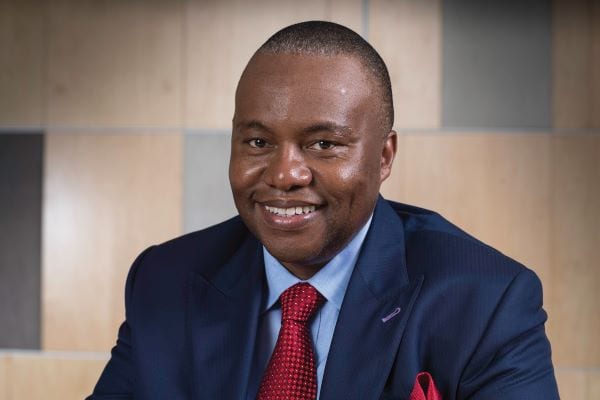
When Themba Mkhwanazi was appointed CEO of Kumba Iron Ore in 2016, significant change was already under way: the business had just been through a restructuring, which resulted in some retrenchments; a new operating model had been introduced to improve operational efficiencies; and technology was becoming an area of focus for the business.
Mkhwanazi has been steadfast at the ship’s helm for almost three years now and Kumba is in a profitable position, despite the sometimes volatile iron ore price. Much of this positive turnaround can be attributed to Mkhwanazi’s leadership approach, a committed team, and a number of strategic developments. “Iron ore prices are not under our control and can be volatile. But my strategy, when I became CEO, was to deliver value by optimising all aspects of performance and focusing on what we could control, which included improving productivity, deploying new technology, improving operational efficiencies, and expanding our margins by achieving higher realised prices while reducing costs,” Mkwanazi states.Exceeding expectations
With the adoption of this operational-performance centred approach, Kumba has since seen impressive financial results. It also had a fatality-free 2017 and 2018 – an especially notable achievement. “First off, as safety is at the heart of everything we do, I am particularly proud that we have remained fatality free since May 2016. This was directly attributable to our programmes focused on embedding a culture of zero harm and ensuring safe working practices by all our employees and contractors. In last three years, we had zero fatalities, with lost-time injuries reduced by 36%. “Overall, Kumba delivered a stronger operational and financial performance in 2019, with headline earnings increased by 239% to R10.1 billion, a strong balance sheet with net cash up R7.1 billion to R18.8 billion, and interim cash dividend of R30.79 per share,” Mkhwanazi states. Kumba delivered an Ebitda (earnings before interest, taxes, depreciation and amortisation) margin up from 36% to 58%. A highly competitive lump ore ratio was maintained at 68%, with an average realised FOB export price of US$108 (R1 580) per tonne. The company’s operating efficiency improved from 63% to 67% in 2019, with cost savings of R460 million, on track to achieve a 2019 target of R700 million. Mkhwanazi asserts that the business was able to achieve this Ebitda by making good on his strategy to influence factors under Kumba’s control, as opposed to relying on dynamics beyond the power of the company – i.e. the iron ore price. “Ultimately, we have been able to return a significant portion of earnings to our shareholders, while ensuring a robust capital structure,” he continues.
Getting the most out of the Kumba portfolio
Mkhwanazi says his focus as a leader continues to be on how Kumba can extract the full potential of its portfolio. “We’ve made some real progress on this over the past year, with a step change in productivity and break-even price, driven by a focus on operational excellence that has been well executed by the team,” he says. Mkhwanazi indicates how, alongside that progress, the business also underwent a comprehensive review to test every aspect of the value chain to see where improvements could be achieved. At the company’s annual results in February, he announced the outcome of this review process with Kumba’s full potential transformation strategy. “Reaching our full potential is a multiyear journey and we have a clear transformation agenda, which will focus on driving our operations to unlock Kumba’s full potential with Three Horizons,” Mkhwanazi shares (see Figure 1). He admits, however, that there is still more that can be done in continuing to improve on the basics, such as better negotiations, understanding customers’ needs, the acquisition of new customers to ensure that Kumba has a diversified customer portfolio, and improving cooperation between marketing and operations to produce the products customers need. “The management team is totally committed to implementing all these measures and, more so, the company is in the best position to deliver sustainable cash flow and shareholder returns through challenging times, like those faced a few years back,” he adds.