New research from the Transition Pathway Initiative (TPI) reveals that just two of the ten largest mining companies are aligned with limiting climate change to 2°C. These 10 companies have a market capitalisation of over $350bn and contribute to annual carbon emissions of over 1.5 billion tonnes either directly or indirectly via their products.
Freeport and Grupo Mexico have such a low emissions intensity that they are already aligned with the 2050 benchmarks, including Below 2C. But their strong climate performance is in stark contrast to others in the sector. Adam Matthews, co-chair of the TPI and director of ethics and engagement for the Church of England Pensions Board, said, “The sector has made significant progress over the last six months.” TPI’s research shows that Glencore and Anglo American are currently within the 2°C benchmark, but their emissions pathways are too flat to keep them in alignment by 2050. Glencore’s plans to cut Scope 3 emissions by c. 30% by 2035 are promising, but do not include its marketing activities. Stated net zero ambitions from BHP, Rio Tinto and Vale only cover operational emissions, typically just 6% of the emissions TPI assess. As a result, these companies are actually further away from alignment in 2050 than they are today. Fortescue and South32 have yet to set credible long-term targets and need to cut their overall carbon intensity by nearly 80% by 2050 to claim alignment with 2C, while MMC Norilsk provided insufficient disclosure for assessment to be possible. “Several companies, including. Rio Tinto, Vale and Glencore, have announced new, more ambitious emissions targets and BHP have acknowledged the role of scope 3 emissions in their future approach,” Matthews said.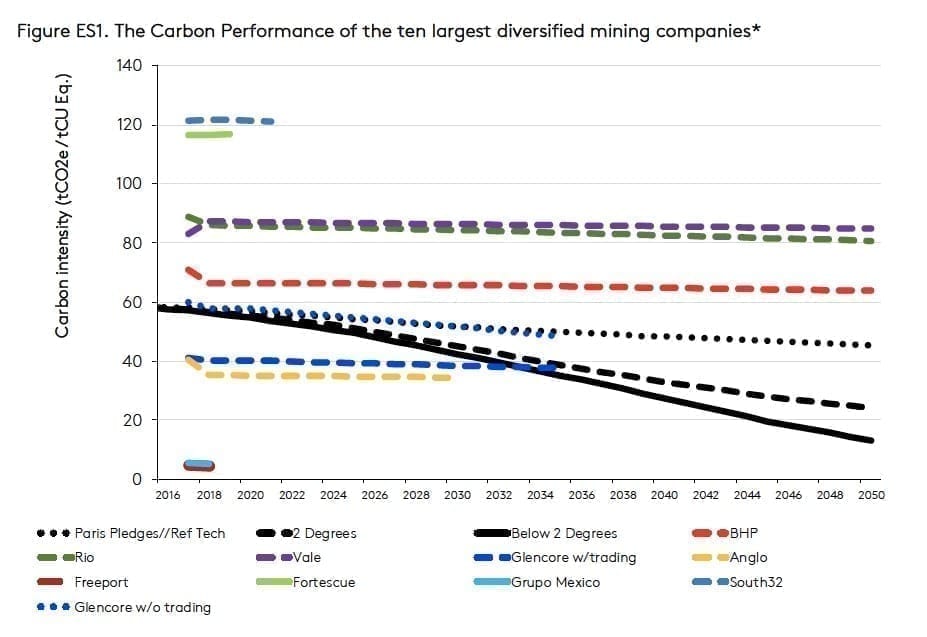
“Many assessed companies mine materials that both support the transition and those that do not. It is essential that investors have a complete picture of their carbon performance, which includes public targets for scope 3 emissions.”
To calculate emissions intensity, TPI’s proposed methodology adds disclosed Scope 1 and 2 emissions with estimates of Scope 3 emissions. Many mining products, like coal and iron ore, generate significant downstream emissions. The TPI calculates Scope 3 by applying emission factors product by product. For a denominator, TPI proposes converting all mining production (including energy products) into a single Copper Equivalent (Cu Eq.) metric. TPI is seeking feedback from investors, companies and civil society on several aspects of its methodology including the choice of emissions factors for different forms of production across the sector and the degree to which trading/marketing activities should be included in companies’ lifecycle emissions, with the aim of improving the methodology further.Decarbonisation strategies for mining companies
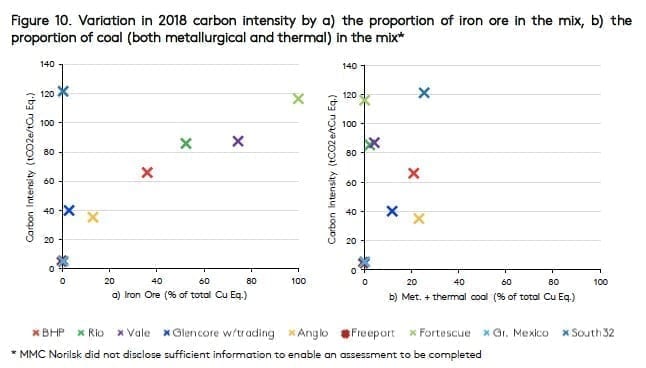
Diversified mining companies extract a wide variety of natural resources from the earth’s crust, from energy products to ores requiring processing (e.g. iron ore into steel, or bauxite into alumina), metals and precious gems. These products vary widely in terms of lifecycle emissions intensities. Energy products generally have high emissions intensities (from 52 tCO2/tCu Eq. for crude oil to an average of 132 tCO2/tCu Eq. for thermal coal). Non-energy products have much lower intensities in general, although iron ore is a notable exception: emissions from steel-making result in a lifecycle emissions intensity of 112 tCO2/tCu. The below graph illustrates the correlation between carbon intensity and the proportion of iron ore and coal in a company’s product mix.