Harmony Gold is a gold-focused mining and exploration company and conducts its activities in South Africa and Papua New Guinea. Harmony was established in 1950 and is currently South Africa’s largest gold producer. Inside Mining interviews CEO Peter Steenkamp.
All photos by Harmony Gold
What makes mining in Africa different compared to the rest of the world?PS I believe that, as a South African mining company, we fully understand the importance of sustainable development and empowering the communities in which we operate. The challenges faced in Africa, and more so in South African gold mining, are unique. Unlike our international peers, our deep-level underground and narrow reefs pose a challenge to full mechanisation and automation. We have, however, implemented modernising and improved efficiencies from an engineering point of view (i.e. digital twinning and optimisation).
We have also introduced and implemented new safety features in the form of predicting and managing seismicity, and the introduction of missing person locators, in the event of an underground fall of ground.
As an emerging market mining company, we have the benefit of our revenue being earned in dollars – which is in our favour in the current economic climate with a much stronger R/kg gold price being achieved (due to the rand’s weakness against the dollar).
What would you say is the most challenging thing about operating in South Africa?
Harmony is a proudly South African company that has been operating here for 70 years. We continue to invest in South Africa and its people, and foresee a long future ahead.
We understand the importance of creating a sustainable business that benefits all its stakeholders, and believe that more stable and certain regulations that are enforced for longer periods will achieve just that.
As South Africans, we need to acknowledge the value that our own country offers. Yes – the gold mining industry may not be what is was in the heydays, but the reason for that is that ore bodies are mined out! The opportunity lies in finding ways of optimising your existing operations and to explore the areas surrounding your mines.
How best did you manage such challenges?
Understanding the needs, expectations and aspirations of all our stakeholders enables us to shape our actions in determining strategy, addressing problems, and allocating resources. It underpins the value creation process. Effective stakeholder engagement helps us to better manage risks, opportunities and challenges. It all boils down to collaborative efforts between the various stakeholders.
What impact do you think the African Continental Free Trade Agreement would have on mine companies operating in Africa?
Our continent is blessed with an abundance of minerals and resources of all kinds. The free trade agreement would allow us to leverage off possible synergies and optimal use of existing and potential infrastructure.
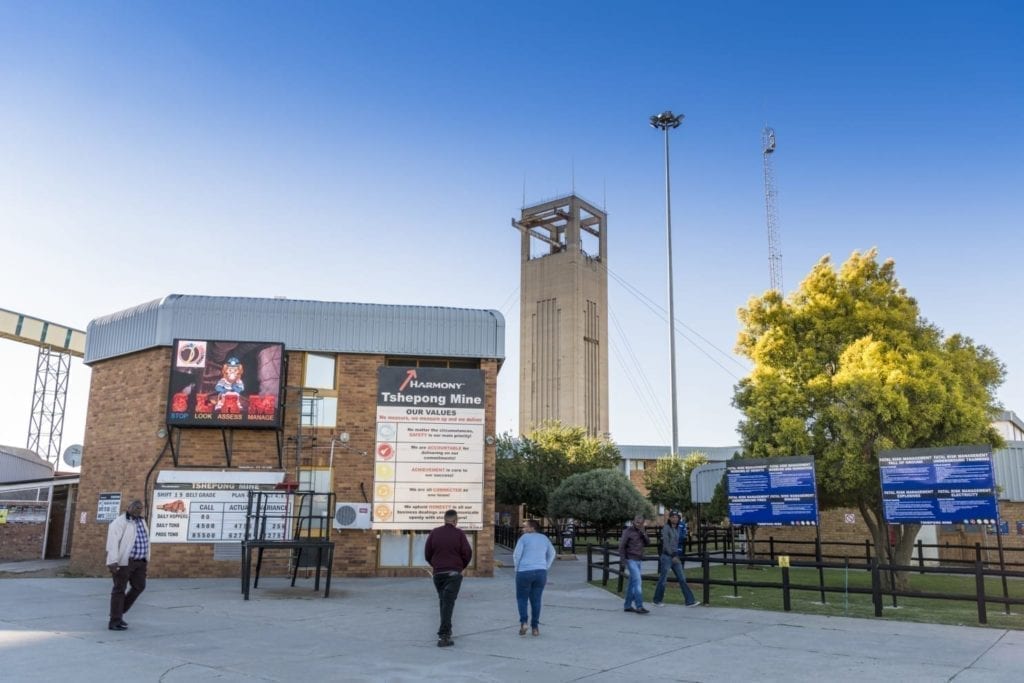
Tshepong Mine is one of Harmony Gold’s operations and is located in the Free State.
In terms of mine operations, what would you say Harmony is doing well and what could you improve on?
Harmony’s strategy is to produce safe, profitable ounces. The company continues to enhance its South African assets through infrastructure optimisation, successful tailings re-treatment, pillar extraction projects, and continuous brownfield exploration at Kalgold and Target North.
We acquired Moab Khotsong from Anglogold Ashanti in March 2018, which has significantly increased our production profile and cash flow. In February this year, we announced the acquisition of Anglogold’s Mponeng and Mine Waste Solution assets.
This will add a further 350 000 oz of gold to our portfolio and increase the life of mine of our asset portfolio. Going forward, we manage what we are able to – safety, production and costs.
What would you say is the biggest lesson Harmony Gold learnt throughout the years operating in South Africa?
We have learned that mutually beneficial relationships with various stakeholders support the success of our business strategy, especially in protecting our social licence to operate. Over the last seven decades, we have demonstrated that a company has the ability to weather any storm – provided it engages with its stakeholders and makes them part of the decision-making journey to ensure the sustainability of the company.
We have also learnt that it is important to adapt to changing commodity prices – as we cannot manage the gold price and the R/US$ exchange rate. As gold miners, we manage what we can –safety, production, costs and relationships.
How has the SA Ministry of Minerals dealt with Covid-19 and what impact did this have on operations?
The leadership displayed by government and particularly the minister is commendable. The president’s initial announcement of the lockdown on 26 March – I believe – was a good pre-emptive move to flatten the curve. It not only allowed government time to prepare for when the number of cases increases, but also allowed us as an industry to ready ourselves and our teams to deal with this pandemic when we start having cases at our operations, as we have just recently seen.
Our number 1 priority remains the safety and health of our employees and that will remain our focus as the South African government allows us to move to full production.
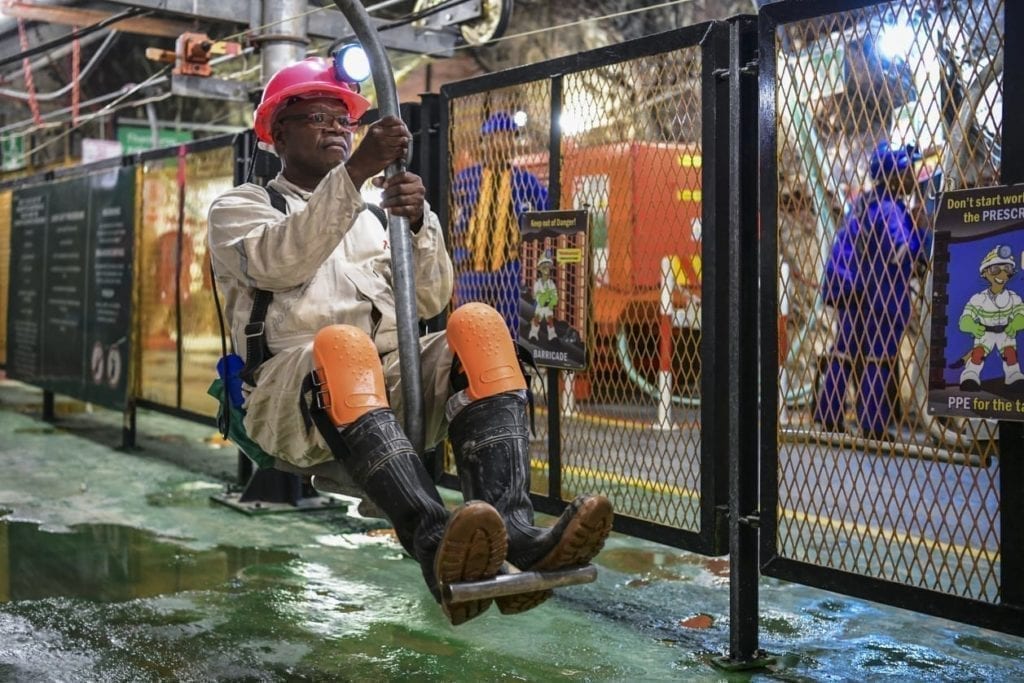
A chairlift system used to access underground mines
What measures did Harmony put in place to curb the spread of Covid-19 at its operations?
Harmony rolled out a risk-assessment-based Covid-19 prevention strategy across all its operations before the lockdown was announced in March 2020 (see our SENS announcement released on 18 March 2020). The objective of the risk assessment is to identify, evaluate and rank the hazards associated with any exposures to Covid-19 and potential infections. It enables the company to reduce or eliminate the probability of an employee contracting Covid-19 and to limit the severity should an employee be infected.
Harmony developed its own standard operating procedures (SOPs) designed to address cases of Covid-19 in alignment with that of the Minerals Council South Africa, and the Guiding Principles on Prevention and Management of Covid-19 in the South African Mining Industry, published by the Department of Minerals and Energy.
So far, the return to, and resumption of, work is in strict compliance with our Covid-19 SOPs and has progressed smoothly.
We recently had an unannounced visit by Minister Mantashe at our Kusasalethu mine. On arrival, the minister was screened and tested before surveying the isolation room. He was satisfied with Harmony’s Covid-19 approach and the controls in place.
We have also conducted our own internal audits to ensure that all our operations comply with our SOPs, as well as the recently introduced Code of Practice.
Where do you see Harmony in the next few years with its African operations?
Harmony aims to grow its ounces to 1.8 Moz by financial year 2021, repay debt, and continue to increase its cash margins generated from its existing operations, organic opportunities and acquisition opportunities in Africa and Papua New Guinea.
We are currently in the process of concluding our acquisition of Mponeng and MWS from AngloGold Ashanti. Once completed, these assets will not only significantly improve our SA reserves (above and below infrastructure), but also support an increased grade profile and boost our cash flow. Our new business development team continues to look for opportunities throughout the continent and in Papua New Guinea – a jurisdiction where we have an existing footprint.
This is also where we have the exciting Wafi-Golpu project, which is a 50:50 joint venture with Newcrest Mining Limited. Golpu, a tier 1 copper-gold asset, is currently in the permitting phase, and project economics set out in an updated study (March 2018) demonstrate significant free cash flow generation.
Would you like to add anything about your Papua New Guinea operation?
The skills we have acquired in South Africa have enabled us to also be a successful miner in another emerging market (Papua New Guinea). The Wafi-Golpu project – once in production – has the potential to be one of the lowest decile cost copper-gold producers in the world. Copper market trends highlight the potential for increased copper prices, further enhancing the economic fundamentals of the project. Wafi-Golpu could be a potential game changer for Harmony in the years to come.