
The digital transformation of the mining industry promises a paradigm shift in performance, with South Africa no exception.
By Peter Clearkin and Tycho Mőncks
For South Africa, the successful modernisation of the mining industry might mean the difference between prospering and slow decline. While the benefits of digital are not in question, the mining industry in general, and South Africa mining in particular, lags behind other industries in realising the benefits that digital will bring. This article outlines the sources of value, explores the roadblocks that stand in the way of digital transformation, and provides approaches to overcome those roadblocks. It concludes with a call for action – what regulators and companies need to put in place to seize the opportunity. Looking a decade back, the mining industry at large was skeptical as to whether digital can bring sizeable value to their operations. As of today, the nature of the ‘Digital Discussion’ has fundamentally changed – it is no longer about whether there is value, but rather about how to capitalise on the value promise, and overcome the many roadblocks mining companies face during their digital journey. As BCG’s Digital Acceleration Index (DAI) reveals, the bottom-line gains of those companies that ‘get it right’ are pronounced – and not limited to ‘just’ operational or financial gains, but also offering benefits for employees such as improved safety and environmental advantages such as lower emissions. As shown in figure 1, BCG’s DAI research highlights that ‘digital’ companies achieve mining throughput improvements of 10% to 20% and emission reductions of 15% to 30%.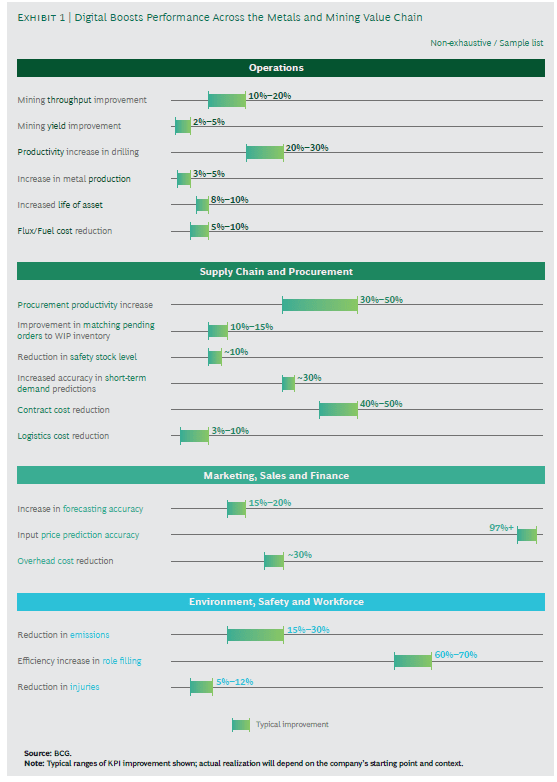
1. Focus on operators’ needs to close the digital strategy-execution gap
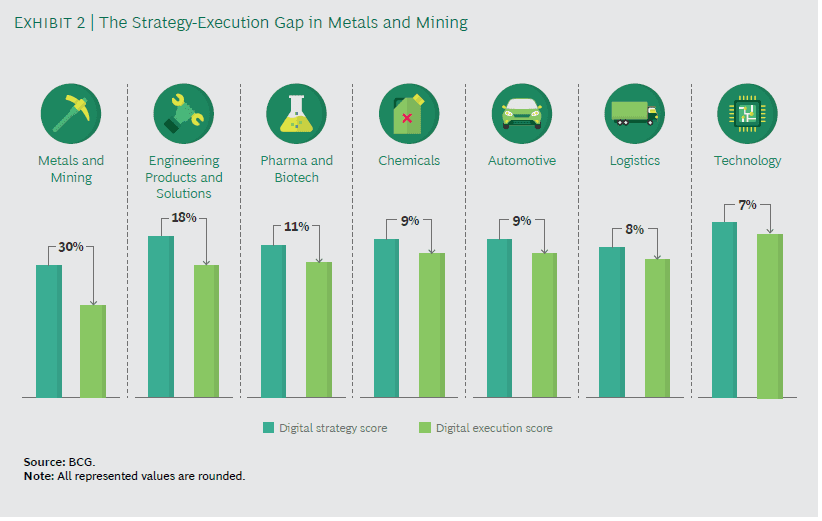
Most metals and mining companies have ambitious digital strategies in place, but the gap between strategy and execution is significant. Our research found three reasons to explain (and, address) this gap.- Lack of customised solutions
- Each plant or mine has unique characteristics: the ore body, the processing and related technical capabilities, the quality of raw materials, and even the skill of the operators themselves, to name a few
- Yet, according to the DAI survey, only 25% of metals and mining companies use customised digital solutions. The rest deploy far less effective off-the-shelf products
- Use of traditional waterfall models instead of agile methods to deploy digital products
- Another reason for the execution gap is that large digital systems are typically deployed using a traditional waterfall methodology, which doesn’t regularly incorporate user input
- As a result, products sometimes don’t match users’ expectations and timelines are delayed
- An inadequate focus on a solution’s sustainability
- Finally, companies must sustain these digital solutions over time, even as operating regimes change, ore body condition varies, deployed equipment and technology alters, and external requirements such as emission and labour laws shift
- Some digital leaders have established digital Centres of Excellence and are upskilling shop floor operators to help design and maintain solutions over the long term
2. Value data assets as much as physical assets
The value of data in digitally advanced industries such as banking and retail is obvious. But for many metals and mining companies, investments in data capture technologies are still viewed as little more than an additional cost. According to the DAI survey, only about 10% of the industry views data as a corporate asset. As a result, mining companies need to shift their perception of ‘data’, and realise it as an intangible, but highly important source of business value.
3. Develop an ecosystem mindset to leverage internal and external partnerships
Digital leaders understand the power of leveraging both internal and external ecosystems, and the benefits of building interconnected solutions on the same digital foundation:- Internal Ecosystems:
- About 15% of the companies in our DAI survey are applying ‘systems thinking’ to establish smart, interconnected internal ecosystems that capture synergistic benefits across the value chain
- Instead of building stand-alone digital solutions that operate in silos, companies are combining them to create a multiplier effect
- External Ecosystems
- There are several ways companies can participate in external ecosystems: they can build a corporate venture capital arm, forge partnerships, or launch new digital businesses. Less than 60% of the companies in our survey have a digital partnership strategy, but those that do can expedite digital adoption and amplify its benefits