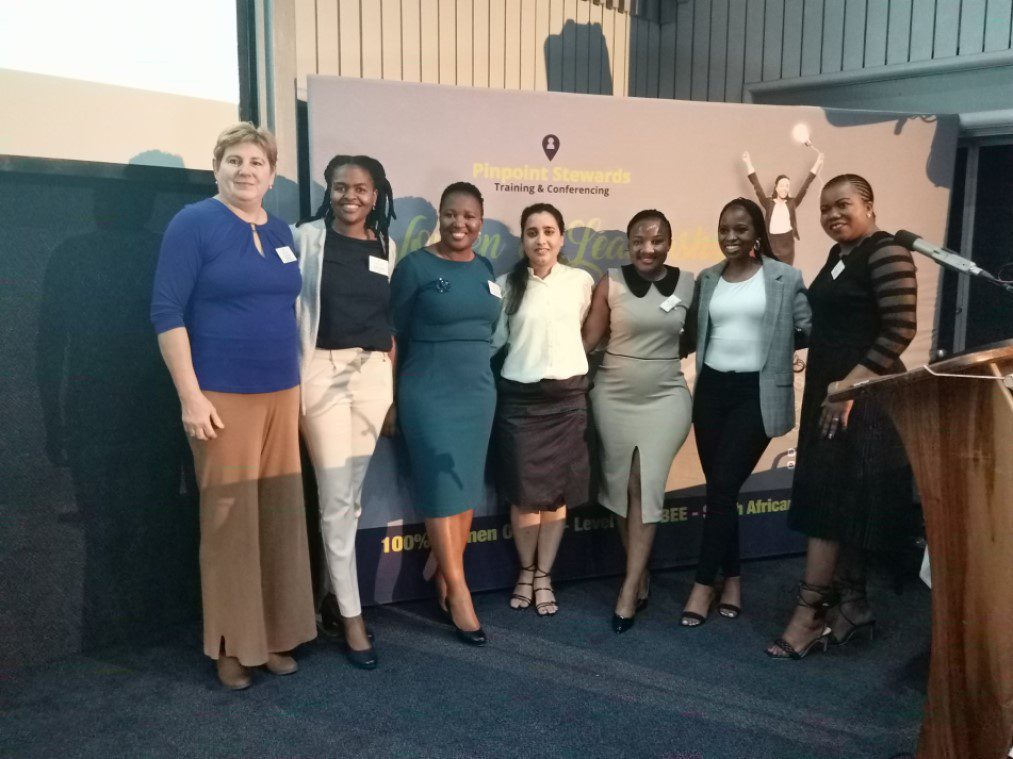
The Women & Leadership in Mining Conference took place on 30 and 31 August 2022 at the Indaba Hotel in Fourways. Hosted by Pinpoint Stewards, the event was well attended by women from different areas of the mining industry.
Speakers on the first day of the event spoke on different important topics, but, shared similar sentiments in that the industry had come a long way in terms of female participation in mining, however, there was still a lot of work ahead to improve the numbers.
Women and sustainable mining
Once the formalities were over and done with, it was time for the first speaker to give her presentation. Nandi Sibanyoni, Executive Head: Safety and Sustainable Development at Anglo American, discussed the contributions of women in sustainable mining. “Sustainability which was once a consideration for businesses is now a priority. This is where we need to take full advantage of being women because we are now in a position where companies are pressured to have women, but we are also at an opportune time to say we can contribute to the course,” Sibanyoni said.
She further explained that increasing awareness of climate change has influenced consumer sentiment which has led to increased scrutiny from investors and higher expectations. “This then means that the scope to attract women in mining is increasing and the expectation is for us to align with sustainable mining.” Sibanyoni stressed the importance of women making it a point to discuss topics related to sustainability within their circles be it at formal conferences or within their social circles.
Her presentation also touched on safety being one of the challenges faced by women in the mining industry as well as the role of technology and modernisation in closing the gender gap. “As the mining industry in South Africa and globally moves into the future, it is increasingly clear that the move to modernisation is critical in addressing the gap between men and women,” Sibanyoni explained. She added that technological advancements not only made the industry less energy and water intensive, but they also made the sector attractive to women who may never have considered a career in mining.
Reshoketswe Zondi, an IT Service Management Specialist at South32 gave a presentation that highlighted how technology can be used to address some of the challenges in the mining industry, including the safety of women in mining. One of the examples she gave was a helmet that could keep track of a person’s movements around a mine. During her presentation, Zondi pointed out that such a helmet could provide crucial data in reported cases of harassment as it could show where a person was during the occurrence of an incident.
As she concluded, Sibanyoni referred to the Mineral Council’s Women in Mining White Paper and encouraged attendees to consult the paper’s seven steps to guide the activities of companies on bridging the gender gap. “When you build your women in mining strategies in your operations, go through these seven steps as an action plan.”
“I am continuously inspired by the quality of the female employees coming up in the industry. We are bringing in good-quality women who are relentless and focused on making mining the best it can be. We all have a purpose, never give up. It is DUE, Develop, Unite, Empower. Together as women, we are unstoppable,” she concluded.
Nandi Sibanyoni from Anglo American
Reshoketswe Zondi from South32
Mentorship and coaching
Caroline Shirindza, Vice President at Sasol Mining was next, and she spoke about how mentorship and coaching can be used as a powerful tool to develop the progression of women in mining. She mentioned that mentorship is for everyone and not only limited to graduates and recruits. “Even now, I’ve got people that I am proud to call my mentors. Some don’t even know they are my mentors.” She further added that mentorship need not be formal where mentors officially sign paperwork to prove that they are indeed mentoring someone. Shirindza explained that a relationship between a mentor and a mentee could be a dynamic one. “You don’t have to wait to be the boss before you can mentor,” she said.
“Mentorship doesn’t mean now I’ve arrived; mentorship means I can share with you. I can share my experience.” She added that mentors are not necessarily senior people in the organisation. “Wherever you are, you can mentor someone. Every day there is an opportunity to mentor someone.” Shirindza mentioned the concept of buddy mentoring where one could rely on a colleague as a mentor.
Shirindza also highlighted the importance of giving recognition when someone does well. She explained that it was more common for women to complement each other on looks but not on achievements, adding that this needed to change. “Look for those moments where somebody has done well, or someone in your team has done well or even your boss has done something you are proud of, say it. People grow from that feedback.”
Caroline Shirindza, from Sasol Mining
In addition, Shirindza also emphasised that mentorship was not a shortcut to success saying that mentees still needed to put in the effort and do the work. She explained that mentors were there to provide guidance and give advice, however, mentees still needed to be committed to doing the work to get to where they wanted to be.
She also distinguished between a mentor and a coach explaining that a mentor would be someone to give advice and guidance and that a coach is a person to partner with to work on achieving specific goals or objectives together. “[These are] two separate processes, both can work,” she said. Shirindza also added that mentorship and/or coaching was a two-way street where both parties had a vital role to play. “Don’t sit and wait for somebody to identify you because it might not happen. A mentor doesn’t have to choose you and the company doesn’t have to appoint a mentor. You can actually go out and find yourself a mentor. You need to make time yourself to reach out.”
When looking for a mentor, Shirindza said it was important for people not to restrict themselves when deciding on who to choose as a mentor and that they should avoid choosing someone who’s already been chosen by many other people. “That person won’t have the time.”
In conclusion, Shirindza said that there were many benefits to mentorship for both the mentor and mentee. “Not only will you benefit yourself and your mentee, but the organisation will benefit as well,” she said.
Bias vs inclusivity – correcting the gender gap
Executive director of NG Global Energy Solutions Reyna Singh followed with a presentation titled: Reforming government policies to promote opportunity for women in mining and exploration – bias vs inclusivity – correcting the gender gap. “Correcting the gender gap starts with us, within our projects, communities, and companies.”
According to Singh, bias is not something that is fixed, it’s something that a person can change, and it’s linked to historical tendencies. “It’s simply a belief. It’s not something that you have to take forward in all that you do.” She explained that inclusivity is the opposite and being open to everyone and not limited to certain people.
Singh explained that addressing bias vs inclusivity was a two-fold approach looking at what more women needed to do among themselves and learning to effectively deal with challenging situations from male counterparts. “We need to have genuine conversations,” she said. She added that it was important for people to be intentional when they reached out to somebody. “If somebody approaches you and you know you cannot help, rather share that contact detail with somebody you know might be of assistance.” Singh also had the following tips to share:
Have databases you could reach out to
Know your skillset and be able to speak about it
Have a reference list of successful tangible projects
Respect other team members
Be hands-on and prepared
Be self-aware
During her presentation, Singh reflected on previous scenarios she had faced that required an assertive response. She gave examples of what a bad response is compared to an assertive response. “This is about correcting the gender gap between us and our male counterparts,” she explained.
Singh concluded by revisiting the initial topic of reforming government policies to promote opportunity for women in mining and exploration – bias vs inclusivity – correcting the gender gap. “We need to build a movement that will inform policy reform. It starts with us as individuals, knowing the technical details and participating.”
Reyna Singh from NG Global Energy Solutions
Being a mine manager
Thabile Kulundu, mine manager at Vergenoeg Mining Company shared what a day in the life of a mine manager is like. She emphasised the importance of understanding a mine’s lifecycle. “You cannot be a mine manager and not understand the life cycle. You cannot be a geologist and not understand the lifecycle. You cannot sit in admin and say, ‘all I need to do is just take calls’ because we are all assets,” she said.
“My main responsibility on a day-to-day basis is making sure that the mining activities run smoothly.” She’s also responsible for resource management and the operational team including contractors. In addition, she needs to ensure that there is a balance between environmental management while ensuring there is continued exploitation of the mineral resources. Kulundu must also keep track of stock as well as ensure that surveyors are checking that contractors are doing what needs to be done. “We would not be able to achieve the bottom line without the right quality and the right quantity”
She concluded by highlighting that women in mining is not just a dream, but a possibility. “Make it possible [and] equip yourself to take those opportunities because you are full of possibilities, you just need to find your space and own it.”
Thabile Kulundu from Vergenoeg Mining Company
Breaking the concrete ceiling
Dineo Phaladi-Magwaza, Specialist UG Mine Modernisation: Technical & Sustainability, Group Mining at Anglo American gave a thought-provoking presentation about breaking the concrete ceiling. Her presentation essentially highlighted how black women faced twice the challenges due to their race and gender. “I want to bring this overall view of how black females specifically are represented in South Africa and in the world.”
She posed a question to the audience asking them how many black women in senior leadership roles they knew. The responses illustrated that although they were there, there were not that many of them. “In terms of Fortune 500 companies, women only represent 8.1%,” Phaladi-Magwaza said. She further added that the 8.1% also included women of different races including white, Latino, and Indian. “Now if you go to black females, there is only 0.4%. We’re celebrating, but the black woman is actually lagging behind.”
She added that only 8% of women occupy CEO roles in the top 40 companies in South Africa, however, black women were a significant minority. Phaladi-Magwaza said this was no different for top and senior management in the mining industry. Speaking about the concrete ceiling, Phaladi-Magwaza explained that it was more relevant to black females. “If you look at most corporations, women that occupy senior roles are usually white females.” She highlighted that women are often included in the statistics of female representation in the mining industry. She acknowledged that although the industry had done well to increase female participation in the mining industry, black women were still the minority in this aspect.
According to Phaladi-Magwaza, the historical and cultural socio-economic factors black women face can be attributed to their exclusion from women in top leadership positions. She explained that in African cultures, historically the boy child was given first preference to education while the girl child was relegated to domestic duties. She added that when the girl child is educated, it is often in careers that are not technical such as admin, teaching nursing, etc. She also pointed out that in schools and tertiary institutions, there are a lot of girls however when it came to being on the job it was the opposite. “We are losing the girl child somewhere along the way.”
Phaladi-Magwaza mentioned that opportunities, mentorship, sponsorship, development, addressing biases, and modernising the work environment are some of the solutions that can assist in getting more black women into senior and top leadership positions. “For me, the most important one is leadership. It takes leadership, whether is black female leadership [or] white female leadership, it’s all about leadership,” she said.
Despite the challenges, Phaladi-Magwaza mentioned that she was encouraged by a large number of black women and girls in schools and tertiary institutions. “Black women have an incredible appetite for learning and preparing themselves for leadership. Despite being relegated to certain roles in society we crave and yearn for opportunities to prepare ourselves for leadership roles.” She identified that there was a wide gap between what black women wanted to accomplish and the opportunities presented to them.
“I want to remind you that as a black female, you are worthy. You’re not what society says you are, you are more than that,” she concluded.