


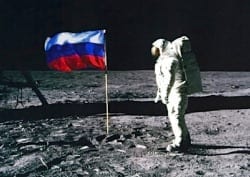
Russia’s mineral exploration on the moon could begin as early as in 2016, with the first spacecraft leaving in 2018 and a manned mission scheduled for 2030.
The Russian Academy of Sciences, the Moscow State University Sternberg Astronomical Institute and the Russian Federal Space Agency are some of the big names behind a $2.5 billion out-of-this-world exploration project, unveiled in August.Rare earth elements
The expedition involves accessing the Earth’s satellite for rare earth elements, used in a variety of industries including green technology, defence systems and consumer electronics. According to Russia Beyond the Headlines (RBTH), the Luna-25 mission will focus on retrieving comets fragments back to the Earth, which could result in a huge breakthrough, as the chemical composition of those celestial bodies remains a mystery to scientists.Moon rich in rare earth metals
The Sternberg Institute’s Head of the Department of Lunar and Planetary Research, Vladislav Shevchenko, told RBTH he believes the lunar surface is rich on rare earth metals.He sees moon exploration as a solution to the current shortage of rare earth metals, whose production is controlled by China, and trusts deliveries from space being potentially more cost-effective than mining for metals at home.

