


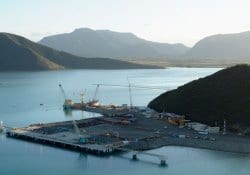
Glencore on Monday announced the inauguration of the Koniambo Nickel Project (Koniambo) in New Caledonia off the coast of France in the southwest Pacific Ocean.
French President, François Hollande officially inaugurated the nickel project and was joined by Paul Néaoutyine, President of the North Province and of Glencore CEO Ivan Glasenberg.Koniambo joint venture
The Koniambo Nickel Project is a joint venture between Société Minière du Sud Pacifique (SMSP) and Glencore. Construction of the mining site commenced in 2007 and represents a $7 billion investment in New Caledonia, which is majority financed by Glencore. Its state-of-the-art infrastructure and proven nickel smelting technology, along with a world-class ore body, makes Koniambo a leading player in the global nickel market and is transformative for New Caledonia’s nickel industry, according to Glencore. At peak production, the mine will provide steady employment for about 950 workers, with a focus on local employment, and indirect employment for thousands of others.
Presidential opening
“We are honoured that the French President has recognised Glencore’s ongoing commitment to and investment in New Caledonia by officially opening Koniambo Nickel,” commented Glasenberg. “This inauguration marks a milestone for our New Caledonian operations and for the country’s nickel industry. We look forward to continuing our well established collaborations with the local community, government and our joint venture partners as we continue the ramp up period to nameplate capacity of 60ktpa.”Responsible mining
Since construction, Koniambo has contributed significantly to New Caledonia, including creating 2 750 direct local jobs and approximately 1 500 indirect jobs. Glencore stated that 85% of contracts and orders placed going to New Caledonian suppliers – 50% of which is from the surrounding Voh-Koné-Pouembout region. In addition, the global miner announced that several initiatives have helped to protect NewCaledonia’s rich environmental diversity, including revegetation of 50 hectares of mined area since 2008, as part of an ongoing program designed to gradually regain the original biodiversity in the maquis areas disturbed by its activities.

