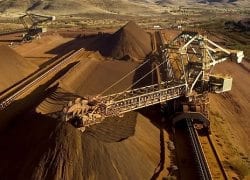
Iron ore slid 4% on Tuesday, bearing on Anglo American’s Kumba Iron Ore that slipped 3.09% on the Johannesburg Stock Exchanged (JSE) on Wednesday.
Iron ore has fallen 48% this year and is now approaching a lowly $70 a tonne its lowest level since 11 June 2009, that is now weighing heavy on producers of the steelmaking material.
Five-year low
Kumba Iron Ore’s shares declined the most of any public entity on the JSE’s benchmark Top-40 index, as the Anglo American unit touched a five-year-low and has lost almost half its share value in 2014.
The Pretoria-based company is the second-worst performing mining company this year on the Johannesburg’s all-share index, owing to the iron ore price slump.
Fall to $60 predicted
With iron ore approaching $70 a tonne and with analysts now predicting a continued slump in iron ore price to less than $60 in Q3 2015, meaning that Kumba Iron Ore and the world’s two largest mining companies, BHP and Rio Tinto, would be the only producers that can operate profitably at current market prices.
On the news of the iron ore plunge this week, BHP Billiton shares fell 1.5% to $32.67, while Rio Tinto shares closed 2.5% lower at $57.98.
In the year-to-date shares in BHP Billiton have slumped 12.7%, while rival Rio Tinto have fallen 12.8%.
China factor
The fall in the iron ore price has been partly associated with concerns that a slowdown in China’s economy will weaken demand for the steelmaking material.
China is responsible for more than two-thirds of the world’s iron ore consumption and forges almost as much steel as the rest of the world combined, but steel consumption is set to drop this year for the first time since at least 2000.
Fears of oversupply in China’s property market is said to have fuelled the more than 4% fall in iron ore prices.
On Tuesday, data from China’s National Bureau of Statistics showed that average price of new homes across 69 of 70 Chinese cities measured slumped for the sixth-straight month in October. In the year to October, prices fell across 67 of 70 cities, according to reports.
Survival of the fittest
It is the smaller miners that are being hit hard because they are perilously close to break-even point, according to reports.
“For those in the high-cost area, it’s a case of survival,” said Mike Elliott, Sydney-based global leader for metals and mining at Ernst & Young. “If you’re only ever going to make money at the peak of a commodity price cycle, then you may call it quits.”
On Monday, China’s largest private steel mill declared bankruptcy while debt-laden Sinosteel, one of the biggest importers of iron ore in the country, are said to be kept afloat only because it is one of only 113 elite state-owned firms centrally managed by Beijing.