


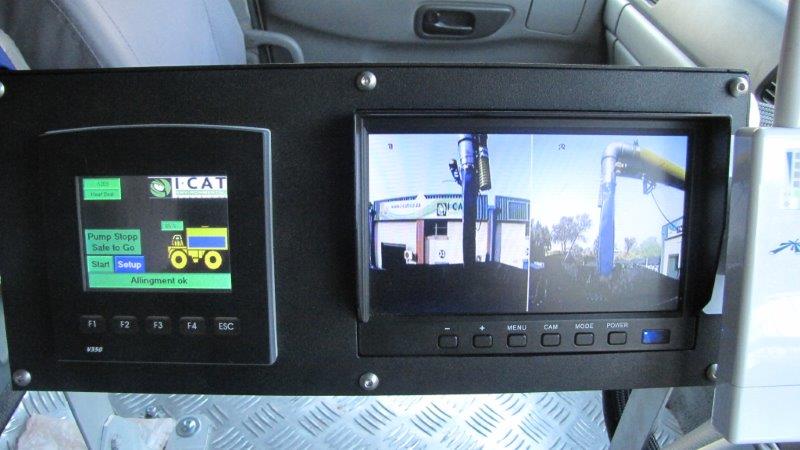
Water is a rare and precious commodity, and spillage and overfilling are a major challenge in the local industry. Traditionally, drivers have to climb out of the vehicle before aligning it with the filling point – with an ever-present risk of human error resulting in misalignment and spillage.
I-CAT director Anton van der Merwe indicates that the main function of the E-CAM and RFID systems is not only to reduce and prevent water spillages and wastages around the filling points, but to also effectively manage and control water bowser activities. “This new technology ensures pinpoint alignment without the driver having to set foot outside of the bowser, which reduces any safety hazards related to the driver being outdoors. It also substantially reduces the risk of spillage, and also leads to significant time and cost savings,” he explains. E-CAMThe E-CAM system is fitted with an intelligent GPS device that is equipped with multiple inputs and outputs. The GPS tracking system has been designed and developed as a web-based software program, with I-CAT building its own hosting platform. “This ensures less downtime and reduces integration issues with firewalls and other related security structures,” van der Merwe continues. Through the development of this infrastructure, van der Merwe indicates that I-CAT maintains and improves the platform continuously. “These improvements will be available to the client as part of scheduled upgrades and releases. Maps are updated on a regular basis due to the high levels of change, development and the extraordinary production targets set in the mining industry.”
What’s more, a programmable ‘snail trail’ allows the status of the dust roads to be monitored. When the operator of the vehicle starts spaying or applying dust suppression onto the roads, the road will start to illuminate green on the mapping software, changing its colour to orange and then to red, indicating the condition of the road after a set period of time.
Van der Merwe adds that the GPS unit is fitted with multiple inputs and outputs that perform various tasks. “These tasks can be monitored and controlled with the software. The E-CAM, with its current infrastructure, boasts the capability to integrate additional and external devices. This equipment can be monitored and controlled through the software and the E-CAM system.” RFIDThe radio frequency identification (RFID) system is a dust suppression management system that consists of numerous features that control and manage the refilling process of water bowsers. The system uses a programmable logic controller (PLC) to control the water and dosing pump at each station. An on-board monitoring and water management solution is fitted inside the cabin of the water truck. “RFID technology recognises each vehicle’s identity, with regards to size and amount of water, as it approaches a filling point. Two alignment cameras then align the tank’s opening with the filling point gooseneck. The vehicle is also fitted with an alignment sensor, which will not allow the water and dosing pump to start if the truck is not lined up correctly,” van der Merwe notes. By pressing a button on the touchscreen display of the PLC, a signal is sent to the receiver to start the filling process. A water level sensor inside the water tank detects when the correct level of water is reached. “The water bowser operator can also monitor tank levels during their trip with the screen, which provides them with the necessary information to plan their routes and trips more effectively to improve productivity,” van der Merwe concludes.

