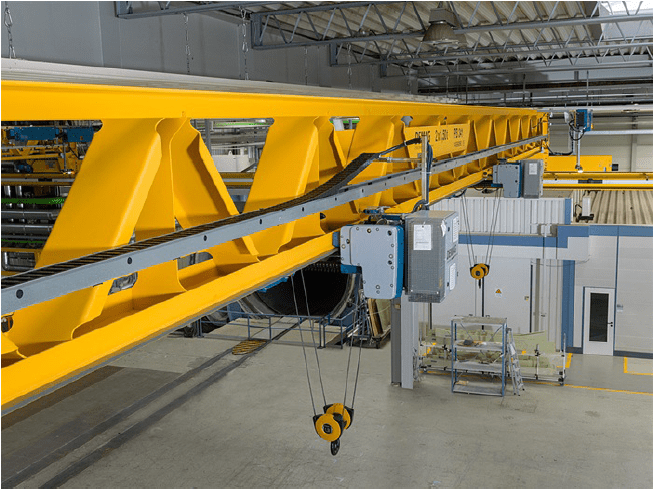
Demag’s newly-launched V-Type crane girder can easily manage more than 500 000 load changes – over double the service life of a conventional box-section girder – making it a game changer in the local material handling sector.

Terex Material Handling product manager Richard Roughley
Demag Senior Manager Sales & Marketing Richard Roughley explains that Demag’s V-Type girder, which was launched in early 2016, delivers safety and impressive load handling rates. “Regardless of the model type selected – the V-Type girder can be easily adapted to any building shape, and is the ideal solution both for existing buildings, as well as for new construction projects.”
The following Demag V-Type girders are available;
Type 1: The ends of the standard crane girder slope at a 45° angle. The bottom edge of the girder is at the same level as the crane runway, offering sufficient space for loads such as pipes.
Type 2: On the compact version, the bottom edge of the V-Type crane is significantly lower than the crane runway. This variant is particularly suitable for projects that offer limited space.
Type 4: The lower edge of the slightly raised crane girder is located higher than the crane runway, which offers a gain in lifting height, making it suited to applications with considerable space.
Type 5: The girder is significantly raised. Its lower edge is located above the crane runway, which provides for a large range of lifting heights.
Type 6: A combination of Types 1 and 2. It can be adapted to suit the available space, since the dimensions above and below the crane rail can be freely selected. The bottom edge of the crane girder is below the level of the crane runway.
Built with safety in mind, the V-Type girder allows 30 percent more light to pass through, enabling personnel to better see their surroundings, while brightening the workspace. This improved view ultimately results in a safer and more attractive working environment. The V-Type girder also has a shorter time cycle, helping to increase productivity and overall output. It boasts several lifting points for safer installation of the load and has more clamping and attachment points for lamps.
Demag’s V-Type girder,
What’s more, the tapered diaphragm joints also replace the solid box-section design of conventional cranes. “Tapered diaphragm joints accommodate pressure and tensile forces more effectively to reduce resonant frequency by 30 percent. On average, the V-Type crane is 17 percent lighter than comparable cranes that have box-section girders. This not only reduces the forces transmitted to the existing support superstructure and provides architects with greater freedom when planning new building layouts, but also improves the relative deadweight-to-load-capacity ratio,” adds Roughley.
The V-Type girder’s energy chain is perfectly matched to the given V-Type crane variant, and is tailored to meet the specific requirements of indoor and outdoor applications, as well as any payload movements. The energy chain provides improved working clearance below the crane, thereby enabling available space to be used more effectively. It also eliminates the need for many standard components that often result in more maintenance and higher susceptibility to repairs.
The V-Type girder features bolted connections for gentler loads on the entire crane system, including the crane runway. Consequently, maintenance costs and requirements are reduced to a minimum. Roughley indicates that absolutely parallel alignment of the machined connecting surfaces forms the basis for secure connections with high-tensile bolts.
“The machined and bolted connections and matching contact surfaces provide optimum alignment of the components, minimising the rapid wear of travel wheels, the crane runway and the rails.”
The V-Type girder was manufactured using eco-friendly processes, in an effort to reduce Demag’s footprint and to increase environmental sustainability. “Our eco-friendly utilisation of resources is reflected by the use of less material, reduced drive output requirements, blast cleaning of metal parts with dry ice and the use of water-based paints. This manufacturing process ultimately results in greener building practices further down the supply chain too,” Roughley concludes.