



New data has revealed that South Africa’s unemployment rate increased to 26.7% of the labour force in the first quarter of 2016, up 2.2% points from 24.5% in the fourth quarter of 2015. StatisticsSA said that employment levels declined quarter-to-quarter in all industries except Community & Social services and Agriculture which grew by 51,000 and 16,000 respectively. The biggest job losses were observed in Trade (119,000), Manufacturing (100,000) and Construction (77,000).
Employment declined by 2.2% points, or 355,000 in Q1: 2016, which combined with an increase in the number of unemployed persons of 521,000 resulted in an unemployment rate of 26.7%. However, on a year-on-year basis, employment was still higher in Q1: 2016 by 204,000 compared to the same period last year, StatsSA said.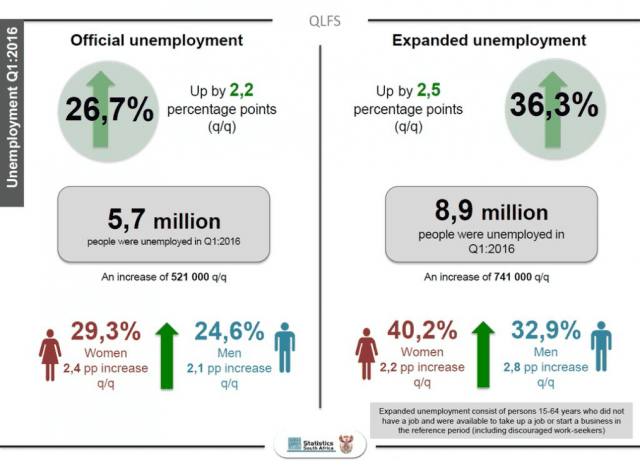
Unemployment rate – Statistics SA
The expanded unemployment rate which includes those who were available to work but did not look for work in the reference period also increased by 2.5% points between Q4: 2015 and Q1: 2016 to 36.3%, StatsSA said.
Mining industry woesIncidentally, the South African mining sector cut 47,000 jobs between 2012 and early 2015 as the industry grappled with soaring costs and low commodity prices, said Roger Baxter, CEO of the Chamber of Mines said earlier this year. Mineral Resources Minister Mosebenzi Zwane said recently a further 32,000 jobs were under threat, and the industry was working closely with the government and labour to minimise job losses. Baxter said the gold industry, followed by platinum and coal, had cut the bulk of the 47,000 jobs in little more than three years. Mining costs had increased by an average 20% a year for the past five years, he said, and electricity was the core component in those cost increases. It was for this reason that there was talk of the 32,000 jobs under threat, Chamber of Mines president Mike Teke said, adding that a large number of companies were talking about retrenchments, restructuring and cutting production, and putting mines into care and maintenance. Time will tell.

