


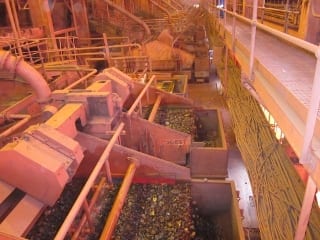
Weba Chute Systems has four chutes to install at Sishen Iron Ore mine in the Northern Cape out of the twenty that were commissioned.
The order involved design, manufacture, supply and installation of the chutes to replace an existing set of 24 at the drum plant, which have been operating for approximately 15 years and can no longer handle the steady increases in capacity, owing to their narrow design. This resulted in frequent blockages, leading to costly downtime and production losses while the blockages were cleared. The existing chutes are also extremely worn and rusted. Ted Cruickshank from M&J Engineering says “The new chutes are large enough to cope with present throughput, as well as future capacity increases. Since commissioning, there have been minimal transfer problems, but a follow-up inspection has been scheduled to ensure the chutes are performing to our standards.” Each chute system is custom-designed for a specific application taking into account factors such as belt width, belt speed, material sizes and shape and throughput. Cruickshank says there are numerous advantages to be gained from this locally developed transfer system, which, when introduced on a new project, achieves the optimum design configuration for the application with the best belt cleaning arrangement and optimum selection of belt type and size. In addition, it is possible that spillage can largely be eliminated. Further benefits that apply equally to retrofitted Weba Chute Systems, such as the Kumba Sishen installation, and new projects alike, include a significant reduction in material degradation, greatly reduced levels of dust and noise, reduced production losses owing to fewer blockages, significantly reduced spillage and vastly improved safety levels.Easy access is provided for inspection and maintenance purposes and the system does not require ongoing supervision, again representing a saving in manpower and related costs.
Cruickshank says Weba Chute Systems should not be compared to conventional chute systems but rather seen as an improved alternative or upgrade because they adopt a completely different and unique approach to the control and handling of bulk materials. For instance, the system uses a “supertube” with a cascade scenario, where 95% of the material runs on material at all times. “When one looks at this process in slow motion, it becomes apparent that the bottom layer of particles in the product stream moves in a tumbling motion and does not slide down the chute,” he explains. “This results in significantly reduced wear and, in many cases, the lip remains completely covered by material and never needs replacement.” This manner of controlling material movement is taken a step further by designing the internal angle of the transfer chute in such a way as to match the product discharge velocity with the belt speed, which either completely eliminates or greatly reduces spillage. Extensive experience and technical expertise, coupled with applications knowledge, has positioned Weba Chute Systems as the leader in its field. The Weba Chute System design is accomplished using sophisticated 3D computer software. Data received from the customer is always verified and, in many instances, Weba Chute Systems’ highly skilled personnel are in a position to make cost saving recommendations.
