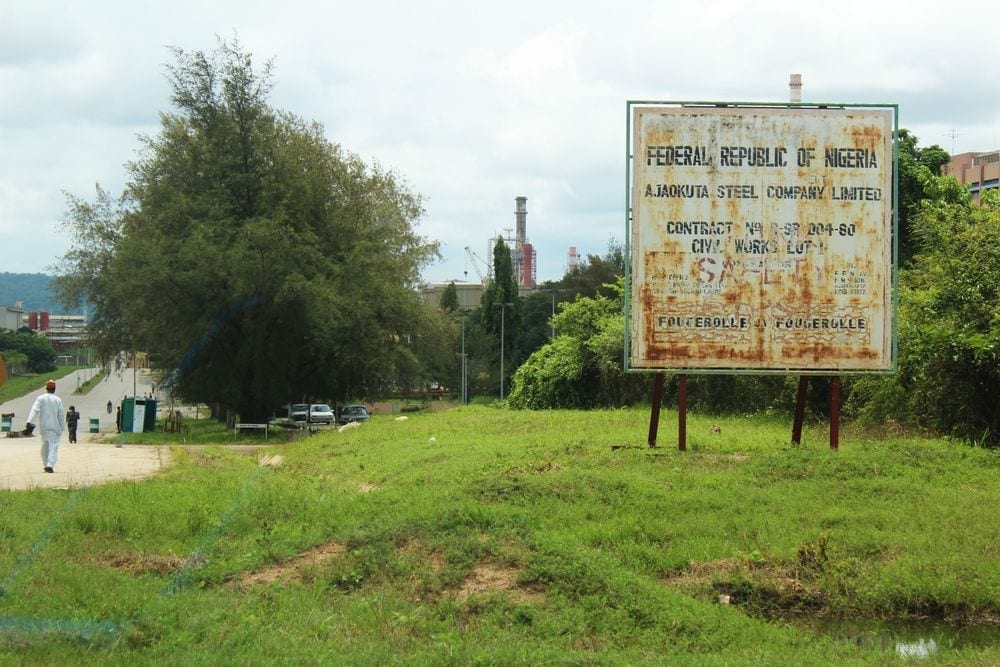
The Ajaokuta steel plant Photographer: David Maligha Doya/Bloomberg
Nigeria’s plan to build a railway to supply iron ore to its idle Ajaokuta steel plant could be the biggest sign yet that President Muhammadu Buhari is implementing his policy to diversify away from oil.
The project began in 1979 and has never been finished. Authorities want to revive it as part of Buhari’s efforts to lessen the economy’s dependence on crude, which accounts for 90% of export earnings and the price of which has dropped 62% from a 2008 record.
If successfully executed, it “would be one of the strongest indicators to date of the government’s stated commitment to economic diversification,” said Manji Cheto, senior vice president for West Africa at New York-based Teneo Intelligence. “How the government deals with this will be important to watch.”
The 275 kilometer railroad will link the plant to an iron-ore mine in the central Kogi state, said Sabiu Zakari, Transport Ministry Permanent Secretary in an interview this month. It will award the operating concession after that, he said.
Dilapidated Infrastructure
The project spans 24 000 hectares, but almost nothing has been completed since building started 38 years back, and most of the infrastructure and equipment is dilapidated.
A blast furnace, conveyor belts, and crane-like structures with “Made in USSR” labels are surrounded by bushes, while weed-covered roads are littered with dung from cattle that graze on acres of land meant to stock materials such as coal.
“We stopped hoping. All we can do now is pray,” said Isah Onobere, 58, who started at Ajaokuta Steel Co as a trainee in 1982 and is now the head of the plant.
The blast furnace, while 98 percent complete, has never been commissioned, Onobere said. This can’t be done “until we have external infrastructure to guarantee supply of inputs like the iron ore and coal, and take out products.” The furnace must operate for at least seven years without interruption to make economic sense, he said.
-Bloomberg