


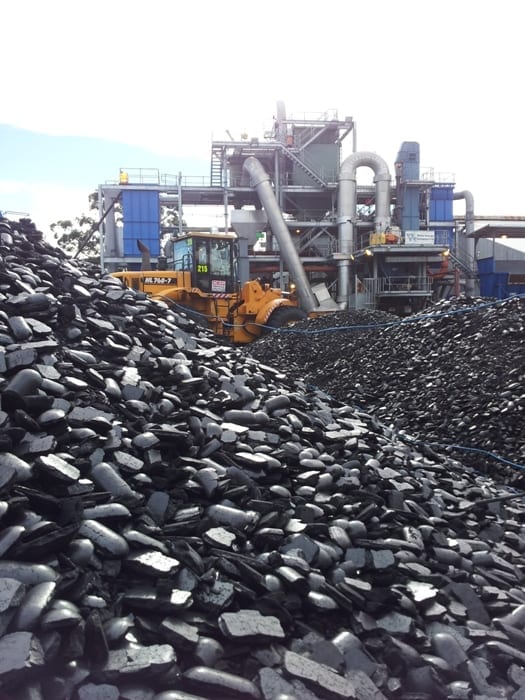
South Africa’s coal reserves may be depleting, but its need for power is not. Until recently, coal fines have been considered uneconomic, environmentally hazardous and difficult to process. Thanks to new environmental legislation and Eskom’s need for additional coal resources, companies are entering the market aiming to create a viable coal fines beneficiation industry, writes Laura Cornish.
River Energy South Africa is one such company – established in 2008 – that is offering the coal market one-of-a-kind technology capable of upgrading discarded coal fines, thereby providing mines with a new cash-generating stream and the country with a solution to its depleting coal resources. The formation of River Energy SA ASX/OTCQX-listed White Energy is the exclusive licensee of a patented technology for upgrading and binderless briquetting of coal fines and high-moisture low-value coals through a low-cost process of dehydration and compaction. Together with its financial partner, Black River Asset Management, White Energy established River Energy JV in Mauritius in order to focus on African coal opportunities. River Energy South Africa was then set up as the first in-country subsidiary to pursue opportunities with South Africa-based coal mines. Delivering a world-class, cash generating solution to a coal deficit crisis Dale McLean, general manager of River Energy JV believes the South African company’s timing could not have been better. “While our initial focus and target was to provide coal mining houses with an additional revenue stream, we believe South Africa’s environmental legislation and increasing need to secure additional coal for energy generation will intensify the demand for our unique coal fines beneficiating technology.” The coal sector contributes over 90% of South Africa’s electricity needs, and this figure is unlikely to change in the foreseeable future. The countries’ larger coal mines, however, are maturing; many on a pathway to closure within the next 10 years. Eskom’s capacity expansion budget is R385 billion to 2013 and is expected to grow to more than a trillion rand by 2026. The state-owned entity will ultimately double its capacity to 80 000 MW by 2026. This presents a massive coal shortage crisis. Considering there are millions of tonnes of coal fines in the ground in addition to what is on surface in tailings facilities, a technology that can deliver a viable product from such material could offer Eskom significant relief in the near future. “We are actively targeting Eskom.It needs to find a solution. We are an important cog in this solution for Eskom.” It is estimated that there are more than 1 billion tonness of discard in South Africa. With more than 300 Mt of coal being mined every year, and depleting every year, there could be up to 60 Mt of additional discard created every year – assuming around 20% of discard is created in the coal mining process. “What we are offering is a solution to South Africa’s looming energy crisis – new and untapped coal,” McLean outlines. River Energy’s BCB technology The briquetting technique is no new concept – it has been around for at least a century. It is based on using binders to hold the coal together, altering its properties and making it less attractive to end users. River Energy, however, is offering a binderless coal briquetting (BCB) technology, which is exactly what its name states – the ability to recover, beneficiate, upgrade and briquette coal fines without binders. It is a patented technology developed by the Commonwealth Scientific and Industrial Research Organisation (CSIRO) in Australia and refined by White Energy, which has been commercialised under an exclusive global licence by River Energy’s parent company. “Simply put, it involves an uncomplicated thermal drying process, followed by the pressing of the briquettes that are held together by the natural bonding mechanisms of coal.” The most effective way to use the technology for current arisings is to integrate it into a wash plant and use it to dry and compress discarded coal fines into higher energy coal. According to White Energy’s technical manager, Jason Nunn, BCB can upgrade sub-bituminous coal to the head value of bituminous coal with none of the adverse effects of using binders. “By taking the moisture out, you increase the energy and create a product that is much more attractive to the market. The result is a high-calorific content and quality that also retains the low emission profile of the feedstock sub-bituminous and can be used interchangeably with other high-ranking coals. Because the price of coal is based on its energy content, with the highest calorific count bringing in the most dollars, BCB technology doesn’t just upgrade coal’s heat value, but also its price.”McLean does not shy away from alternative fines upgrading technologies. Flotation and filtration are viable options, but flotation is fairly capital intensive, has high operating expenditure and only works on certain coals.Filtration is effective, but is capital intensive.
According to McLean, River Energy JV is one of only two global companies looking to successfully commercialise the BCB technology. “In South Africa, we are the binderless technology leaders.” The characteristics of binderless briquetting are:- no additives to the fine coal feedstock, thus no increase in the volume of the feedstock
- a consistent burn profile of the briquette and the host coal
- no effect on the volatiles of the briquette compared to the host coal
- no effect on the ash content of the briquette compared to the host coal
- no increase in the variable costs as briquette production volume is increased
- plant scalability (up to 1 Mtpa)
- the ability to briquette wet feed material including feed to thickener.
- beneficiate and upgrade low grade feedstock
- reduce moisture content to improve economics (sub-bituminous and bituminous)
- recover fines (waste) and create a saleable product
- solve materials handling challenges typically associated with fines
- create large, scalable briquetting plants
- tailor briquette characteristics according to market requirements
- create products that customers will buy
- reduce carbon dioxide emissions
- lower the risk of combustion
- reduce volume of slurry
- improve performance at power stations
- enhance transport efficiency
- reduce sulphur content.

