


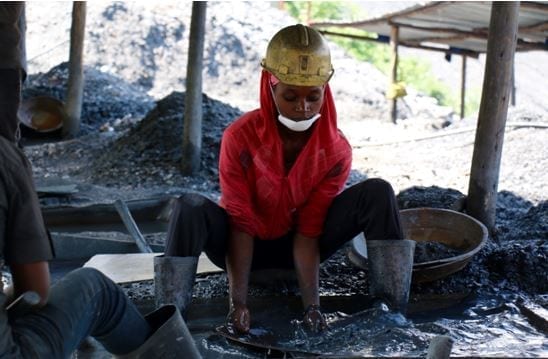
 Rising mineral prices and the struggle to earn a living from agriculture have led to explosive growth in artisanal and small-scale mining (ASM), according to a new report from the Intergovernmental Forum (IGF) on Mining, Minerals, Metals and Sustainable Development.
The report noted, as ASM relies on a mostly unskilled workforce using rudimentary tools and techniques, its environmental and health and safety practices tend to be very poor. In many countries, 70 to 80% of small-scale miners are informal. Informality underpins the sector’s poor performance and traps the majority of miners and communities in cycles of poverty and exclusion from legal protection and support.
“Formalisation has to include miners’ views and it needs to include measures to effectively monitor and enforce regulation,” said Fitsum Weldegiorgis, one of the report’s authors and a senior researcher at the International Institute for Environment and Development (IIED), which was commissioned to research the report. “Streamlined licensing processes that make it easy, cost-effective and rewarding to obtain a licence will help. As will technical and financial support to meet the licensing requirements and—once licensed—will continue to improve performance,” he added According to the report, a roadmap towards a more responsible and inclusive ASM sector requires:- Know-how: Building capacity through local institutional partnerships
- Organization: Encouraging miners to form cooperatives and associations
- Collaboration: Encouraging large-scale mining companies to support capacity building
- Capital: Using microcredits to lend to organized groups of miners and communities, supported by donors
- Technology and equipment: Improving miners’ access to efficient and cleaner technologies

