


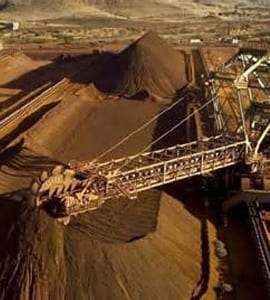
There are signs of heightened interests by mining companies around the world in what is believed to be the world’s next Pilbara iron ore-rich region.
West Africa is abuzz with iron ore exploration projects and mining licence applications. Reggie Sikhakhane looks at the progress of some of these projects. West African countries such as the Republic of the Congo, Guinea, Nigeria, Cameroon and Sierra Leone are said to have untapped iron ore reserves that may be able to supply the world’s ever increasing demand for iron ore-dependant products such as steel, over the long-term future, so much so that the area has been likened to Pilbara in Australia – one of the richest iron ore destinations in the world. While the majors (BHP Billiton, Rio Tinto and Vale) remain focused on expanding their current operations in Australia, a new population of juniors has emerged, all focused on developing their iron ore projects in West Africa and cashing in on the demand for iron ore. Should all these projects, for both majors and juniors, start producing, analysts predict it will have a detrimental impact on the long-term price of iron ore as supply will exceed demand substantially. South Africa-based diversified miner African Rainbow Minerals (ARM), chaired by one of Africa’s wealthiest businessmen, has also signalled its interests in the West African region recently. Patrice Motsepe, ARM’s chairperson, visited Guinea and met with the country’s president, Alpha Condé. Motsepe said that the visit was inspired by ARM’s interest in iron ore and infrastructure related to iron ore. It is believed that an investment by ARM into iron ore mining in Guinea could boost investment appetite in that country, which has been negatively affected by a violent political landscape over legislative elections, as well as Guinea’s mining code. Exxaro is another major investing millions of dollars into its Republic of the Congo-based Mayoko iron ore project – the result of its acquisition of ASX-listed mining company African Iron for AU$313 million (R2.84 billion) in 2012. The Mayoko iron ore project, situated in the south-west of Congo, is on a 1 000 km2 tenement and has a confirmed ore reserve of 685 Mt. The project is expected to deliver 2 Mtpa of iron ore, with first production expected in the second half of the 2013 financial year. Exploration activity AIM-listed resources company Sable Mining Africa recently announced that it will drill-test an extension to the area of mineralisation covered by the recently completed JORC resource report at its Nimba iron ore project in Guinea. The company revealed that the extension area is approximately 200 m wide and up to 3.9 km in length, with an exploration target potential of between 45 and 80 Mt of canga. Sable added that the extension has the potential to increase the Nimba project’s current JORC resource from its current 121.5 Mt. “The Nimba project has already demonstrated itself to be one of West Africa’s premier high grade iron ore deposits, and the significant mineralised extension on two of the three plateaux further reiterates the quality of the deposit and the commercial value of its development. “We are now focused on a further drill programme to better define the enlarged resource potential of the Nimba project, adding to the current JORC resource of 121.5 Mt at an in-situ grade of 57.8% iron. In conjunction with this exploration work, the company continues to advance its logistical solutions and accordingly, we are pleased with the progress made in this region,” says Sable Mining CEO Andrew Groves. Australian resources and investment company Cape Lambert Resources confirmed that an environmental licence has been granted for its 100%-owned Marampa iron ore project located in Sierra Leone. The Marampa project is currently at the permitting and development stage, and located 90 km north-east of Freetown in Sierra Leone. Marampa comprises two granted exploration licences held by Marampa iron ore, which is indirectly a wholly owned subsidiary of Cape Lambert, with a total JORC mineral resource of 680 Mt at 28.2% iron covering four deposits (Gafal, Matukia, Mafuri and Rotret).Cape Lambert says that the awarding of the environmental and mining licences will significantly de-risk the Marampa project and adds value from a potential investor’s perspective by clearing the way for the development of the project.
“The granting of the environmental licence is another step toward progressing the Marampa project to eventually become Sierra Leone’s third iron ore producer. Marampa has been demonstrated to be a financially robust project, and gaining the necessary governmental approvals will significantly enhance the asset’s appeal to potential buyers, in turn adding significant value for our shareholders. A number of interested parties are currently in the Marampa data room reviewing the project details,” explains Cape Lambert’s executive chairperson Tony Sage. The two existing iron ore producers in Sierra Leone are London Mining, which owns the Marampa iron ore mine, and African Minerals, which owns the Tonkilili iron ore mine. Kogi Iron, an Australia-based iron ore exploration and development company, has advised that it has completed an additional 30 hole diamond drilling programme at its 100%-owned Agbaja iron ore project located in Kogi State, in Nigeria. A total of 726 reverse circulation (RC) holes were drilled, including 138 RC holes completed in the current dry season programme, covering an additional 1.2 km2. RC drilling has been carried out at a spacing of 200 m x 100 m within the stage 1 resource area. The current exploration Target 1 estimate for the channel iron deposits and overlying laterite on Kogi’s land holdings is 1.6 to 2.7 billion tonnes at 35 to 50% iron. This estimate includes 1.2 to 2 billion tonnes at 35 to 50% iron within the Agbaja project exploration licence. Undoubtedly one of the largest deposits in the West African iron ore region, the Mbalam-Nabeba iron ore project, overseen by ASX-listed Sundance Resources, is located in Cameroon and extends into the Republic of Congo. It has a probable iron ore reserve of 436.3 Mt. This project is also at an exploration stage, with Sundance announcing that it is seeking a strategic partner that will help the company run and manage the large-scale project. Both Cameroonian and Congolese governments have expressed support of the project, adding that the project is of a national interest and are eager to see it being developed. Sundance is also undertaking investigations into port and rail infrastructure mechanisms. Outlook The West African region is said to benefit significantly from the development of iron ore mines, which will bring the much needed infrastructure and improve the logistics network of the region. China, the world’s largest iron ore consumer, is poised to increase its demand for steel, a product with iron ore as a key ingredient, and West Africa will seek to supply this demand. Notwithstanding, there are important factors that will determine the flourishing of the West African iron ore region. Political stability, the mining tax and legislative regime as well as the concerned governments’ willingness to work with the private sector on issues such as infrastructure development are all key. For the moment, iron ore prices are expected to remain strong into 2014 on sustained demand in China. Iron ore reserves are depleting in other regions of the world and the West African iron ore region could capitalise on this. Recently, India’s role as a major supplier in the seaborne market was defined as being in “terminal decline” after mining was suspended in the states of Karnataka and Goa and exports were capped. According to a Morgan Stanley report, availability of material has remained tight amid low iron ore stocks at the ports, traders and steel mills. It adds that on the demand side, it believes “the combination of a recent sharp drop from record high steel inventories and a high level of steel output in China suggests strong iron ore consumption in the country.”
