


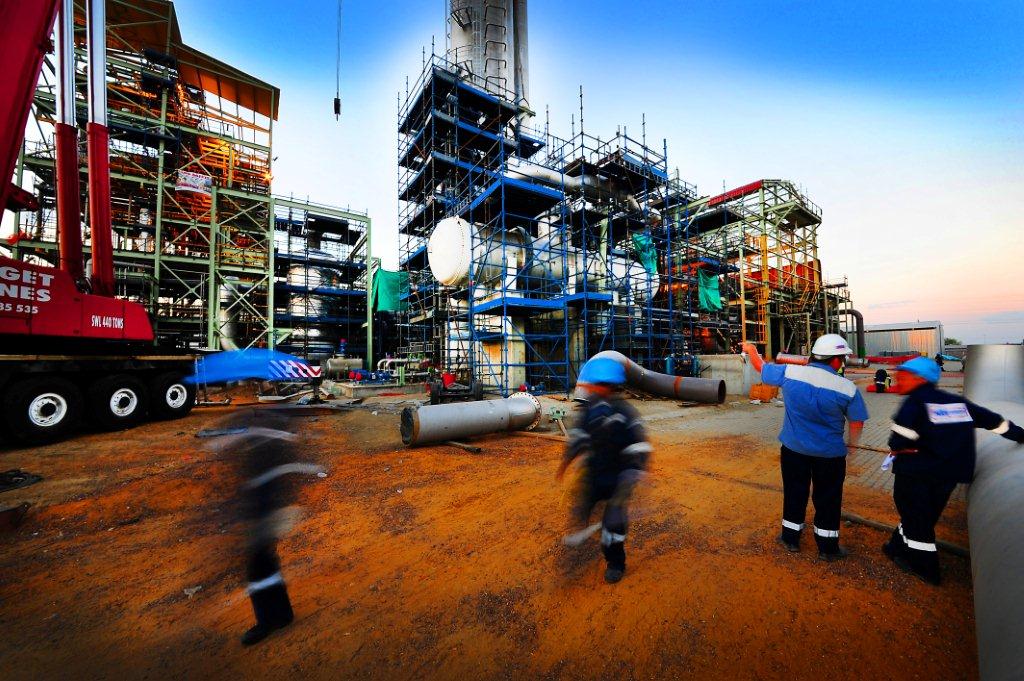
The African mining sector is set to benefit from a more secure supply of explosives after blasting specialists BME’s holding company Omnia officially opened its new energy-efficient and low-emission nitric acid plant in Sasolburg.
Rod Humphris, Omnia Group MD, officially opened its world-class nitric acid complex in Sasolburg, which started operating towards the end of March 2012. This complex is the first of its kind to be built in South Africa for many decades and represents a milestone investment in the development of South Africa to produce nitric acid . It will also alleviate the pressure Omnia experienced as a result of an increasing shortage of this critical raw material. The complex comprises a nitric acid plant, an ammonium nitrate plant, a porous ammonium nitrate plant, a fleet of 145 specialised ammonia rail tankers and other ancillary facilities. The nitric acid plant will produce 1 000 t/d, which is 40% more than the current plant. The R1.4 billion facility will boost South Africa’s nitric acid output by 330 000 tpa, increasing the country’s overall output capacity to about 1.4 Mtpa. It will also reduce the need to import nitrogen products necessary for the manufacture of explosives for the minerals industry. “This added production will improve BME’s security of supply, which means that it can further improve its service offering, particularly to countries within the Southern African region,” said BME MD Francois Hay, who noted that the recent upsurge in mining activity in Africa had strained the supply of mining equipment, skills and other inputs. “Because explosives form the basis of most mining operations, mine owners have actively been seeking solutions to their twin requirements of security of supply and the diminishing pool of skills available in this arena,” said Hay. The company already holds a significant market share in the explosives industry in West and Southern Africa, and is expecting to further improve its competitive position. Hay added that BME had developed a stable emulsion product that could be safely transported across vast distances without compromising quality. According to BME, the new production capacity puts it – through the Omnia group – in the same league as competitor Sasol, which previously dominated the market with about 50% of nitric acid produced.The new plant also boasts impressive ‘green’ credentials, having installed cutting-edge EnviNOx technology from ThyssenKrupp Uhde of Germany, to eliminate greenhouse gas emissions.
The technology, which is already in place at the group’s older nitric acid plant in Sasolburg, will allow the new plant to generate about 400 000 t in carbon credits annually at full load, in terms of the United Nations Framework Convention on Climate Change. According to Danie Oosthuizen, group project director, all nitric acid plants produce greenhouses gases, but the EnviNOx process effectively destroys 98% of these gases by converting them in a reactor into nitrogen and water vapour. “In line with government commitments to reduce outputs of greenhouse gases, we have invested considerably to ensure that our plants are environmentally friendly,” said Oosthuizen. The new plant is also self-sufficient in terms of its electrical energy needs, even generating more than it needs for its own processes and ‘exporting’ electrical energy into the local Omnia grid that feeds its Sasolburg operations. “The process of making nitric acid is exothermic, generating heat that we then convert to steam,” said Oosthuizen. “We use this to drive the heart of our plant – the compressor train – and still have excess steam to drive an electricity-generating turbine. “This allows us to be effectively independent of Eskom’s national energy grid, and to feed some into the Omnia network on the same site.” Omnia recently became the first company in sub-Saharan Africa to be issued in excess of one million Certified Emission Reductions (CERs) by the Executive Board of the Clean Development Mechanism Protocol. Omnia has to date been issued with a total of 1 076 015 CERs, 42% of the total quantity issued in Southern Africa.
