The impact of the coronavirus (COVID-19) is having a profound and serious impact on the global economy and has sent policymakers looking for ways to respond. China’s experience so far shows that the right policies make a difference in fighting the disease and mitigating its impact—but some of these policies come with difficult economic trade-offs.
Hard choices
Success in containing the virus comes at the price of
slowing economic activity, no matter whether social distancing and reduced
mobility are voluntary or enforced. In China’s case, policymakers implemented
strict mobility constraints, both at the national and local level—for example,
at the height of the outbreak, many cities enforced strict curfews on their
citizens. But the trade-off was nowhere as devastating as in Hubei province,
which, despite much help from the rest of China, suffered heavily while helping
to slow down the spread of the disease across the nation. This makes it clear
that, as the pandemic takes hold across the world, those hit the hardest—within
countries but also across countries—will need support to help contain the virus
and delay its spread to others.
High costs
The outbreak brought terrible human suffering in China, as
it is continuing to do elsewhere, along with significant economic costs. By all
indications, China’s slowdown in the first quarter of 2020 will be significant
and will leave a deep mark for the year.
What started as a series of sudden stops in economic
activity, quickly cascaded through the economy and morphed into a full-blown
shock simultaneously impeding supply and demand—as visible in the very weak
January-February readings of industrial production and retail sales. The
coronavirus shock is severe even compared to the Great Financial Crisis in
2007–08, as it hit households, businesses, financial institutions, and markets
all at the same time—first in China and now globally.
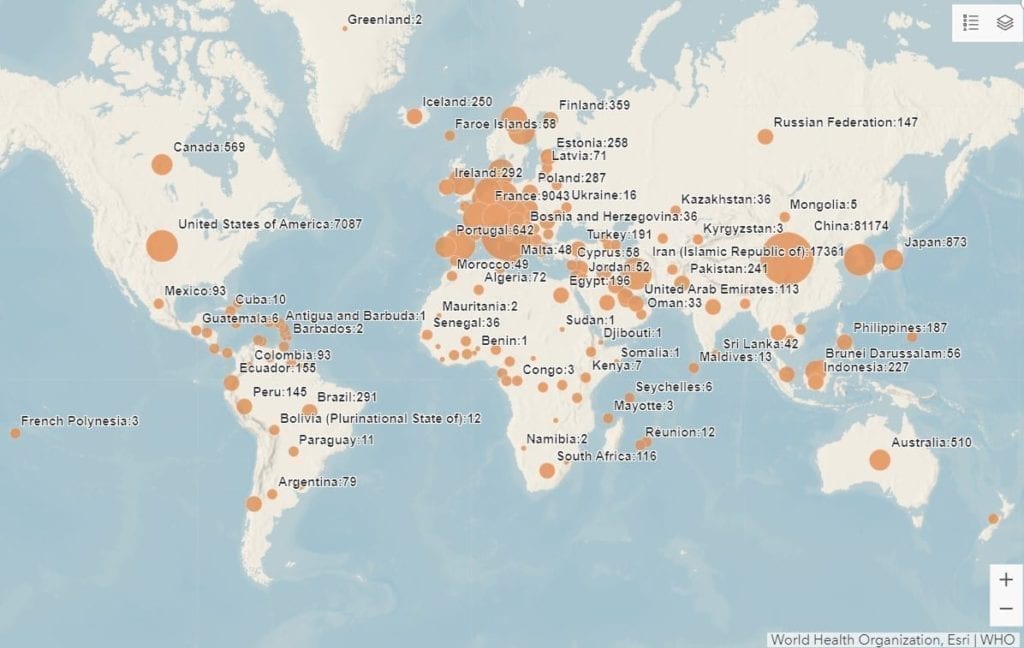
The coronavirus is a global pandemic. Source: World Health OrganisationQuick action
Mitigating the impact of this severe shock requires providing support to the most vulnerable. Chinese policymakers have targeted vulnerable households and looked for new ways to reach smaller firms—for example, by waiving social security fees, utility bills, and channeling credit through fintech firms. Other policies can also help. The authorities quickly arranged subsidised credit to support scaling up the production of health equipment and other critical activities involved in the outbreak response.
Safeguarding financial stability requires assertive and
well-communicated action. The past weeks have shown how a health crisis,
however temporary, can turn into an economic shock where liquidity shortages
and market disruptions can amplify and perpetuate. In China, the authorities
stepped in early to backstop interbank markets and provide financial support to
firms under pressure, while letting the renminbi adjust to external pressures.
Among other measures, this included guiding banks to work with borrowers
affected by the outbreak; incentivising banks to lend to smaller firms via
special funding from China’s central bank; and providing targeted cuts to
reserve requirements for banks. Larger firms, including state-owned
enterprises, enjoyed relatively stable credit access throughout—in large part
because China’s large state banks continued to lend generously to them.
Of course, some of the relief tools come with their own
problems. For example, allowing a broad range of debtors more time to meet
their financial obligations can undermine financial soundness later on if it is
not aimed at the problem at hand and time-limited; subsidised credit can be
misallocated; and keeping already non-viable firms alive could hold back
productivity growth later. Clearly, wherever possible, using well-targeted
instruments is the way to go.
Not over
While there are reassuring signs of economic normalisation
in China—most larger firms have reported reopening their doors and many local
employees are back at their jobs—stark risks remain. This includes new
infections rising again as national and international travel resumes. Even in
the absence of another outbreak in China, the ongoing pandemic is creating
economic risks. For example, as more countries face outbreaks and global
financial markets gyrate, consumers and firms may remain wary, depressing
global demand for Chinese goods just as the economy is getting back to work.
Therefore, Chinese policymakers will have to be ready to support growth and
financial stability if needed. Given the global nature of the outbreak, many of
these efforts will be most effective if coordinated internationally.