


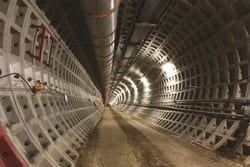
A well-versed mining expert will tell you that no two mines are alike. A trip to Gem Diamonds’ Ghaghoo mining project in Botswana reveals this statement to be entirely true writes Laura Cornish.
Although a traditional kimberlite deposit, theoretically speaking, Ghaghoo couldn’t be more different, or more ‘special’ – and it is still in development phase. Acquired by Gem Diamonds in 2007, the intention was to inject massive capital into the project, develop a massive open-pit, and mine large tonnages. As was the case with so many projects, however, 2008’s economic crash saw companies pull their purse strings tighter; Gem Diamonds included. This meant the asset required a different approach to see it not only produce diamonds, but reach its full potential. “A small underground mine was undeniably the way to go. Because the reserve is relatively shallow – approximately 80 m below surface – we chose a decline tunnel as the preferred access to the diamondiferous ore,” says Gem Diamonds’ COO Alan Ashworth. In Ghaghoo’s case, simpler in theory than in practice. The pipe is located about 45 km within the south eastern border of the Central Kalahari Game Reserve, a remote area recognised for its beach sand-like qualities. And it is this exact sand that buries above the Ghaghoo ore body (for some 70 -80 m). “Developing a stable, strong and safe decline (at an 8 degree angle) through 457 m of sand has been our greatest challenge, but we have overcome it due to our construction approach,” Ashworth points out. A hydraulically operated open-faced tunnel shield was specially designed and is used to support the tunnel development while it is lined with concrete segments – 10 segments constitute one ring supporting the 6 m diameter decline. While such technology or methodology is not new (it was similar to that used to build London’s extensive underground system), it has never been used in a decline. Redpath Mining Botswana is responsible for the decline development, and despite encountering challenges associated with such unusual ground conditions, has performed remarkably well. Construction for the decline portal commenced in July 2011 and the decline tunnel development commenced in January 2012, and now, two years later, the transition from sand to more stable basalt rock is under way. Geotechnical experts have been deployed to site to ensure the transition occurs smoothly and safely as the tunnel support structure changes from a cement ring lining to extensive roof bolt support. The lined tunnel comprises 775 rings in total and demonstrates the integrity that any new decline tunnel should offer. “We have tracked our progress closely and whilst we have not met our original project targets, we are now on track to reach our revised timeline, which should see us mine our first ore in June 2014,” Ashworth notes. Ghaghoo will be mined using the sub-level block caving method. The first horizontal mining level – 154 m below surface – enters the high grade ‘VKSE’ phase of the ore body (the pipe comprises three different facies). For now, it should take approximately one to one and a half years to mine each new level in the VKSE, “it would, however, be ideal if we could mine horizontally right across the pipe through all the phases,” Ashworth notes. “Perhaps in time we will.” The DMS plant, designed to process around 720 000 tpa of run-of-mine (ROM) material, is expected to recover approximately 230 000 carats per annum from, is complete and only waiting for commissioning. It was designed and built by diamond engineering specialist Consulmet on a turnkey basis. It incorporates an AG (autogenous) mill in order to achieve better liberation with greater fine diamonds recovery. Once production starts While the primary objective is to retrieve the first set of diamonds, and sell them, a mid- to long plan and strategy has already been devised. “We are quietly confident that our diamond results will be better than our current expectations, but will plan Ghaghoo’s future on the successes achieved in its first six months of diamond production. Ultimately, we would like to expand the mine substantially.” It is a large ore body and can accommodate a long lifespan. The plant has also been designed for expansion. “This is a new greenfields mine and our first full-scale development. It has been challenging, but there is nothing we have not been able to overcome. We are excited about the potential of the resource and believe the kimberlite to be a good resource. It has also revealed some interesting coloured stones, including blues, pinks and oranges,” Ashworth surmises. Infrastructure to accommodate a remote locationGem Diamonds has invested substantially into the necessary infrastructure to support the project, which includes a fully equipped tented campsite that accommodates up to 400 people. There is electricity, hot water, Wi-Fi, satellite television and even a games room for recreation. Heavy duty multi-traction vehicles are also provided to transport workers, most of them citizens of Botswana, to and from site – for 160 km of weathered, sandy road.
There is plenty of water – extracted from a 300 m deep aquifer via boreholes. Power is derived from a diesel generator plant, sufficient to run the mine once in production. “We are, however, already investigating renewable energy potential sources,” Ashworth notes. Ghaghoo’s grade Unusually, the mine’s reserve grade is higher than the resource grade, because of the additional liberation expected from autogenous milling. Ashworth expects an average grade of 32 cpht in the VKSE phase of the pipe The ore body has been extensively explored and even comprises a defunct exploration shaft and tunnels. Resource data has been gathered from several different sampling campaigns conducted since the early 1980s. To date, it has an indicated resource extending to 400 m below surface and an inferred resource to 524 m. Uplifting safety Redpath Mining South Africa MD Ockert Douglas recently visited the Ghaghoo site as part of a roadshow campaign to promote the importance of safety in the workplace to more than 600 employees across its seven worksites. “Safety is a core value of our business and our Fatality Prevention Programme contributes towards a sustainable future for the current and future employees of our business, and this initiative is fully endorsed by me and my management team,” he explains. Douglas gave a presentation on the Redpath programme to more than 100 workers at Ghaghoo where he highlighted the main objectives of the programme, which includes commitment from leaders to implement the programme; to engage all employees in the process of fatality prevention; and to ensure universal compliance with Redpath’s cardinal rules and fatal risk elimination protocols. “The Fatality Prevention Programme is multifaceted, and has been developed to work with and enhance existing safety systems,” says Douglas. He reveals that a low or decreasing injury rate does not guarantee that fatal risks are being adequately managed. “A more formal and standardised global programme refines our fatality prevention efforts and will improve results, with the ultimate goal being the elimination of fatal risks and fatalities in the workplace.” With this in mind, the Redpath Fatality Prevention Programme has developed the following protocol of 10 ‘cardinal rules’ that should be adhered to by all employees at all times:- never move or operate machinery or equipment without the appropriate training and authorisation
- never tamper with, or make a safety device inoperable
- always correctly isolate equipment from all energy sources before working on it
- never remove another person’s personal underground access tag or personal lock
- never enter an area that has access prohibiting barricades or signs without authorisation
- never work or travel under unsupported ground or suspended loads
- never work at height above the site’s prescribed distance or within the site’s prescribed distance from open holes without suitable fall protection
- always comply with explosives, blasting and re-entry procedures
- never operate heavy equipment within 10 m of any pedestrian without first establishing and then maintaining positive contact
- always park equipment securely so that it cannot move in an uncontrolled way.

