January 25, 2022 marked three years since the Brumadinho tailings dam disaster, which happened at Vale’s Córrego do Feijão mine in Brazil in 2019.
By Dineo Phoshoko
The tailings disaster sent shockwaves through the industry and made international headlines for many weeks. The tailings dam collapse created massive damage to the environment as well as mine infrastructure and surrounding areas. In addition, more than 250 people lost their lives, making this one of the most catastrophic events in mining’s history. The Brumadinho dam disaster had social, environmental and human consequences and also led to changes in the scope of tailings storage facilities (TSF). In an interview with Mining News, Adriaan Meintjes, Partner and Principal Geotechnical Engineer at SRK Consulting, explains that the failure of the Brumadinho TSF led to a significant review of international standards, fundamentally changing the scope of TSF design and management globally. Not too long after this tailings disaster, the International Council on Mining and Metals (ICMM), the United Nations Environment Programme (UNEP) and the Principles for Responsible Investment (PRI) co-convened the Global Tailings Review with the aim of establishing an international standard for the safer management of TSFs. Meintjes explains that within 18 months, the Global Industry Standard on Tailings Management (GISTM) was published in August 2020. The convention of the Global Tailings Review, as well as the drafting of the GISTM, is an important step taken by the mining industry to ensure that history does not repeat itself when it comes to TSF failures.Global Industry Standard on Tailings Management
Led by Dr Bruno Oberle, the GISTM is aimed at the adoption of global best practice on TSF design, construction and management. The Global Tailings Review website states that the standard was developed by a multi-disciplinary expert panel, with input from a multi-stakeholder advisory group. Furthermore, the review involved extensive public consultation with affected communities, government representatives, investors, multilateral organisations and mining industry stakeholders – and is informed by existing best practice and findings from past tailings facility failures.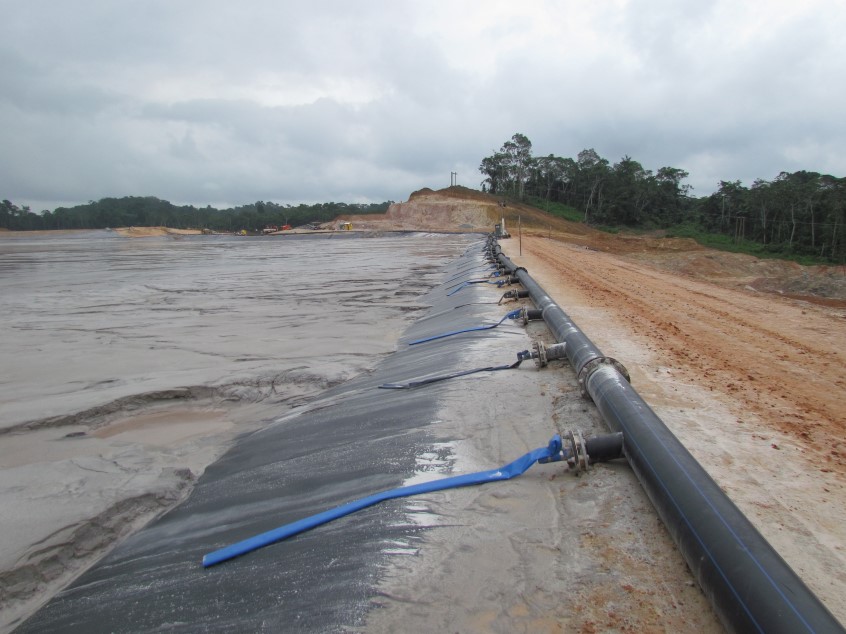
Image Credit: SRK
TSF from a South African perspective
Although the Brumadinho disaster happened in Brazil, it’s impacts were felt closer to home in South Africa. Local mining companies took the initiative to ensure that operations on TSFs are compliant and up to standard. “With its proud heritage of mining, South Africa has enthusiastically embraced the requirements of the GISTM in a number of ways,” he says. “Implementing the GISTM requires suitable and relevant design standards, and these are being addressed in the updating of SANS 10286.” Meintjes also outlines the work that has been ongoing on at least three different levels, since the publication of the GISTM: Level one: All members of the International Council on Mining and Metals – who include the major mining companies operating in South Africa – are working towards meeting GISTM requirements by 5 August 2023. Level two: Other mining firms are following a similar route in terms of meeting their GISTM obligations. Financial institutions now also require compliance with the GISTM for project finance and insurance.
In addition to the three levels above, Meintjes explains that South Africa has various laws and regulations related to tailings dam management. “Among the most important are the Water Act – particularly those clauses related to water pollution and dam safety – and mining regulations enforced by the Department of Mineral Resources and the department of the environment,” he says.
There is also the Code of Practice for Mine Residue Deposits, a national standard outlining fundamental objectives, principles and minimum requirements for best practice. “These aim to reduce risk and prevent negative legacies for future generations,” he says. “It is being updated in line with the GISTM and ICOLD documentation. This standard is to be published as an update to SANS 10286.”Tailings dam management challenges
Running a mine operation safely and successfully is no easy task. The same can be said of tailings dam management. The GISTM is a powerful resource that can assist the mining industry to identify and address challenges relating to TSFs. However, even with the standard, difficulties still remain, especially when it comes to implementing the GISTM. Meintjes identifies skills and experience as one of the major challenges associated with effectively applying the GISTM’s requirements. “The workload for engineers and scientists working on tailings dams is now even greater, and the mining industry faces a global shortage of professionals with the necessary specialised training and time in the field. Consider that each TSF requires a design team, an operating team and at least one review team. In our experience, it is also vital that these teams are multi-disciplinary, with experience in all the different aspects of tailings dams,” he explains. Applying the new standards is a laborious yet necessary task; therefore, Meintjes highlights that many more experts will be needed than are currently available in the market. “As a leader in tailings design and engineering, SRK Consulting has invested considerable resources in developing these skills – but the field is very demanding and the development process cannot be rushed.” The other challenge speaks to education and training. According to Meintjes, the University of British Columbia in Canada is currently the only known institution in the world that offers a focused degree on tailings management. “It is likely to take a long time to achieve adequate staff complements, not just in South Africa but globally, to meet the demands of the extended scope of work envisaged by the GISTM.”Effective collaborations
As with most issues faced by the mining industry, collaboration with various stakeholders is critical in ensuring that another TSF disaster is avoided. In addition to the Global Tailings Review, there is the Investor Mining and Tailings Safety Initiative which was also established following the Brumadinho disaster. Chaired by the Church of England Pensions Board and the Council on Ethics of the Swedish National Pension Funds, the initiative aims to improve understanding and transparency related to the social and financial risk associated with tailings dams. It works to ensure that best practice and standards in the management of mine tailings are implemented. The initiative is supported by 112 international investors with over $14 trillion in assets under management. According to the Church of England Pensions Board, 79 companies representing a third of companies with tailings dams (by market capitalisation), have committed to implement the new GISTM or are assessing their alignment to it. “We are encouraged by the number of companies that have confirmed they will adopt the Global Industry Standard or are assessing alignment,” says Adam Matthews, Director of Ethics & Engagement at the Church of England Pensions Board. He does however warn that any company that sets itself against the Standard could potentially face considerable scrutiny from investors.