


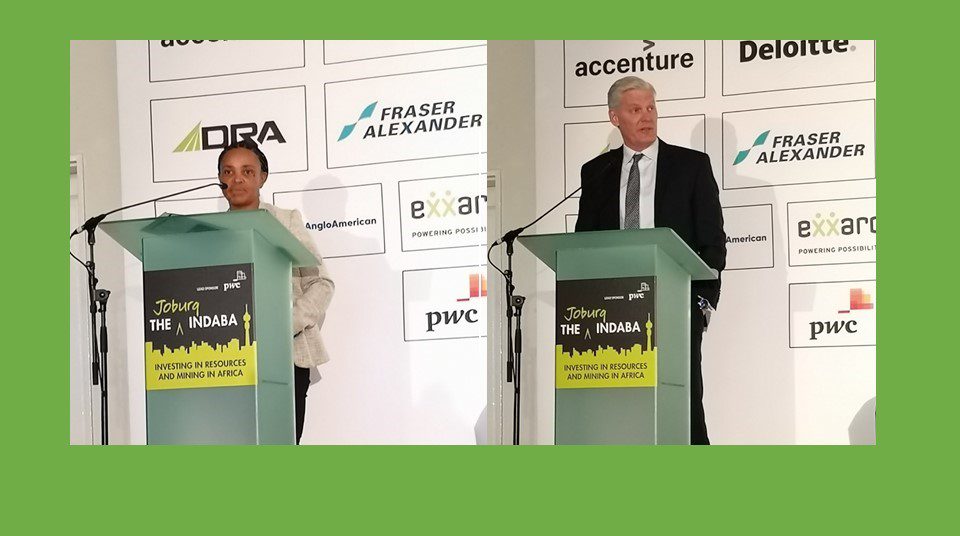
The Joburg Indaba once again put the spotlight on important issues facing the mining industry and finding long-term sustainable solutions to challenges affecting the industry.
The two-day event took place on 05-06 October 2022 was in its tenth year. Over the years Joburg Indaba has become well known for being highly engaging and interactive, where delegates have robust and constructive conversations on a wide range of critical issues affecting all stakeholders in the mining industry. The 2022 event was no different and it certainly delivered. Bernard Swanepoel was the chairperson of the Indaba and with his usual tongue-in-cheek comments, he highlighted the importance of South Africa’s mining industry for the country’s economic development and sustainable future. “We are going to have today, but in the fun, we are going to say the things that need to be said. We are going to reflect on an industry that unashamedly saved hundreds if not thousands of lives during Covid – and saved our economy,” said Swanepoel while delivering his chairman’s welcome. With excitement, Swanepoel also highlighted that this was the first in person event since the outbreak of the Covid-19 pandemic. “On behalf of everyone involved in this event, I would like to welcome you back after this unprecedented period. In recognition of the contribution of the mining industry during the Covid-19 pandemic, the Mining Medical Community was recognised and honored as part of the South Africa mining hall of fame awards ceremony at last night’s gala dinner. “We also had the privilege of inducting both Mxolisi Mgojo and Neal Froneman as two of the most worthy recipients.”Quality speakers and solid partnerships
Swanepoel mentioned that he was impressed with the calibre of speakers for the 2022 Joburg Indaba which included senior level executives from the mining industry, government, SOCs, organised labour and public policy thinkers among others. The topics at the event covered several diverse themes including challenges and opportunities for the mining industry both internationally and in South Africa. “As always we aim to create a platform for open, honest and frank conversations between all stakeholders so that everyone’s perspective is heard, and we can understand how to move forward together for the benefit of the industry and the country as a whole,” he said. He also acknowledged the role and contribution of industry partners and sponsors in making the event a success. “This event started as an idea and over the last five or six years we formed relationships with the mining industry to the point where we can truly say we are by the industry – for the industry.” Swanepoel also pleaded with mine companies to support their local businesses involved in the supply chain the same way they supported the Joburg Indaba over the years. “I almost want to challenge mining companies. If you want to make a success of supporting your local businesses in your community or in your area, or just in South Africa, think [about] how you support us as Resources 4 Africa and see if that model is applicable to other suppliers in your supply chain. “It is phenomenal to be able to wake up and the first thing you worry about is not whether your invoice is going to be paid. So, the very same mining companies that treat us with such respect, please do that to your whole supply chain, and our economy will look very different,” said Swanepoel. The speaker lineup included keynote addresses from Nolitha Fakude, President of the Minerals Council South Africa; Roger Baxter, CEO at the Minerals Council South Africa; Mike Teke, CEO of Seriti Resources, Mark Cutifani, Director and Consulting Business Executive; André de Ruyter, Group Chief Executive at Eskom and Portia Derby, Group Chief Executive at Transnet. All keynote speakers addressed issues at the heart of the mining industry.Sunset or sunrise industry
In his address, Baxter mentioned that he’s often confronted with the question of whether South Africa’s mining industry is a sunset or a sunrise one. In his response, Baxter explained that he looks at South Africa and sees the country on the same competition level with the likes of Australia which also has a dominant mining sector. “We have an incredible capability. We just seem to spend a lot of our time disabling that capacity as a country.” Baxter also emphasised the significance of the mining sector in South Africa. He explained that despite the many challenges faced by the country, there were many opportunities for the mining sector to excel. According to Baxter, the opportunities lay in the country’s mineral resource endowment, and material pipeline of skills from world-class educational facilities to name a few. Concerning a pipeline of skills, Baxter explained that Queensland – a state in Australia – no longer had mining and engineering degrees being offered at any of the universities in the state. “We’ve got a surplus of mining engineers coming out of our universities that we can’t employ because we are not growing our sector fast enough. We should be doing something about that. In some areas we’ve got fantastic infrastructure, we’re just not the service levels on that infrastructure that we need.” Baxter concluded by highlighting that a lot of work was being done with the government to address various issues including security, getting a world class cadastral system in place and a better exploration plan to improve the country’s mining industry.“So, the very same mining companies that treat us with such respect, please do that to your whole supply chain, and our economy will look very different”Bernard Swanepoel
New energy capacity for Eskom
In his keynote address de Ruyter mentioned that during his first system update presentation in January 2020, he explained that at least 4GW – 6GW of new capacity was urgently needed in South Africa. He explained that the new capacity would enable the power utility to take units offline to do the necessary maintenance. Eskom is launching other innovative solutions that will not only add much-needed capacity to the grid but also contribute to environmental sustainability. One of those is leasing land close to power stations with grid access to connect large quantities of renewable energy to the national grid. De Ruyter was excited to announce that the first lease agreement was to be signed in October 2022. On 14 October 2022, an agreement between Mainstream Renewable Power and Eskom was signed in which would see a 1 650-hectare site where Mainstream plans to build and operate renewable energy plants. The lease agreement will run for 25-30 years. This agreement is one of four similar agreements signed by Eskom which will contribute hundreds of megawatts of renewable energy to the national grid. The land is located next to the Majuba and Tutuka coal-fired power stations in the Mpumalanga Province. In addition, there is a pipeline of 6000MW of registered embedded generation projects that will also add new capacity to the grid. De Ruyter emphasised that realistically 50GW-60GW of renewable capacity needs to be added to the grid by 2030 which will require an investment of R1.2 trillion in infrastructure. “There is no way that Eskom can do this. We just don’t have the balance sheet. There is no way that the fiscus can do it. The way to do it is for electricity customers and electricity producers to come together and using the unbundled Eskom as the market platform, to create this new industry which I think is a very exciting development going forward.” De Ruyter was pleased to mention that President Cyril Ramaphosa had intervened and established the National Electricity Crisis Committee where regular meetings take place between government and Eskom employees to resolve the national energy crisis. “We are trying to work with our colleagues in government to ensure that we can solve this as quickly as possible. Remove the roadblocks, cut through the red tape, and make sure that we can restore energy security,” de Ruyter concluded.Transnet’s plan to address capacity constraints
During her keynote address, Derby mentioned that Transnet was pursuing a network capacity creation plan which aimed to ramp up the capacity in certain commodities. Between 2022 and 2031 Transnet’s planned ramp up capacity target is approximately 42.35 million tonnes per annum (mtpa) across manganese, iron ore, coal, magnetite and chrome. On the port side, initiatives have been undertaken by Transnet Port Terminal (TPT) and Transnet National Ports Authority (TNPA) to improve operations at the Richards Bay ports to adequately support the mining sector. Some of the initiatives include:- Restoring conveyor belts that were damaged by two fire incidents in October 2021
- Implementing a truck management system to minimise truck congestion
- Creating an additional truck staging area within Port limits
- Upgrade the roads within Port limits to accommodate current volumes and future anticipated volumes

