


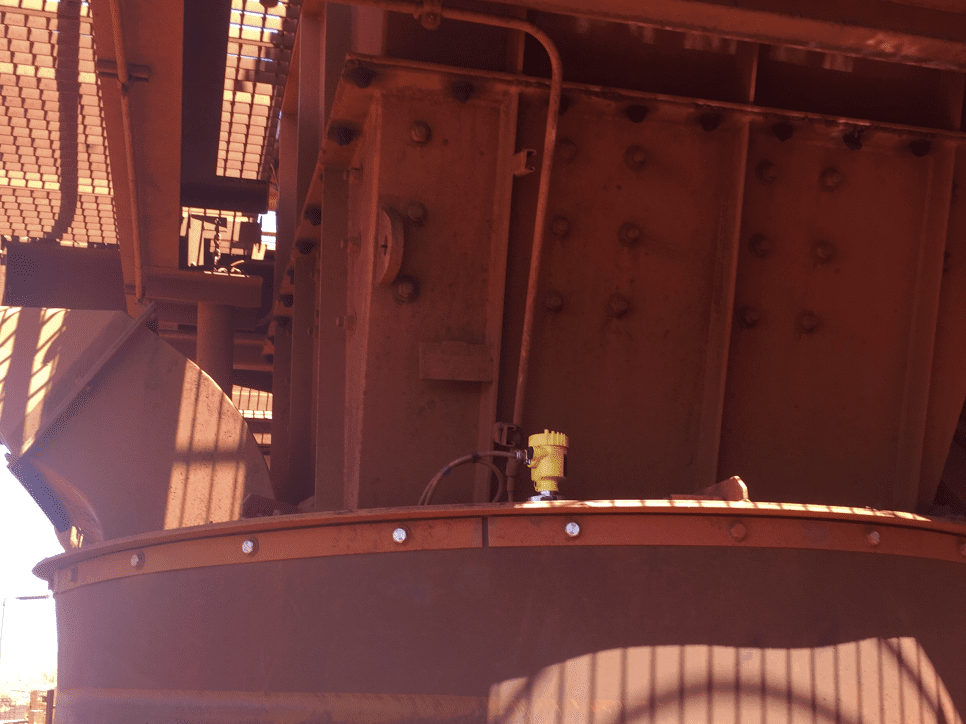
Through the deployment of Vegapuls, an Australian iron ore mine that experienced continuous supply bottlenecks realised a series of operational improvements, whereby processes were better coordinated, bottlenecks eliminated and efficiency increased.
Recently, an Australian mining company failed to meet its export tonnage targets, resulting in a supply shortage for its customers – an unfortunate situation for all concerned. As a result, the mine launched an investigation at one of its main sites to identify and eliminate any bottlenecks. Every process was examined in detail – from the first blasting, feed into the main plant, setup of the crushers and operational parameters implemented in the area, to loading the iron ore onto the trains that transport the raw material to the export ports. One problem area the team discovered was an unreliable level-check of the ore in the crushers.Troubleshooting
Working at this particular plant for a long time, Vega has always provided the impetus to introduce new technology. In 2004, the company introduced the world’s first radar level sensor for bulk solids, the Vegapuls 68, which it installed across the entire site at the time. Accordingly, Vega was approached again with the current requirements for process optimisation. To find a solution to the current problem, Vega investigated the secondary and tertiary crushing processes, finding that the sensor could not follow the current level during rapid filling and emptying processes. In addition, the wide opening angle of the existing sensors resulted in considerable interfering reflections, which repeatedly led to incorrect measurements. Upon further investigation, it was found that relocating the installed units to improve performance would only lead to other issues. The customer was then shown the latest developments in radar technology – the 80 GHz radar sensor, which was launched in 2016 – promising a significant potential for improvement in these applications. In radar technology, the width of the beam is determined by two factors: the operating frequency and the diameter of the horn antenna. The devices installed so far worked with 26 GHz and had a horn diameter of 95 mm, which resulted in a beam angle of 8 degrees. This repeatedly led to the situation where the crusher was being detected instead of the ore.With the Vegapuls 6X, the transmission frequency is 80 GHz, which allows for a beam angle of 3.5 degrees – an improvement of more than 50%. Improvements in the speed of response from the new Vegapuls 6X would also allow for the transmitter to keep up with the fast-changing level of the ore inside the chamber. So, Vega initially supplied some test instruments and supported the customer during setup after installation.

