


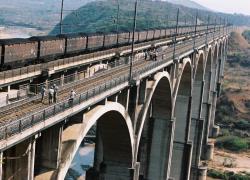
Transnet Freight Rail‘s Project Shongololo will run directly from RBCT to the mines in Mpumalanga, significantly reducing train handling processes.Transnet Freight Rail (TFR) is introducing a new 200 wagon train service on its export coal line, which will run directly from the Richards Bay Coal Terminal (RBCT) to the mines in Mpumalanga, giving the company the capability to exceed 81 Mtpa in the next financial year, should the coal be available. The new service, called Project Shongololo, entails bypassing the Ermelo yard leg of the service, which will significantly reduce train handling processes. Prior to the introduction of the service, trains were built at the Ermelo yard through a process where 100 empty wagons were dispatched to the mines for loading and then returned to the Ermelo yard to be built into 200 wagon trains, which were then forwarded to RBCT. This process was cumbersome, involving significant train handling and shunting to couple and decouple wagons. Commenting on the initiative, TFR chief executive Siyabonga Gama says this service will drastically reduce cycle times from an average of 58 to 41 hours for locomotives and for wagons a decrease from 63 to 48 hours. “Decreasing the handling processes of trains will allow for higher reliability, which will equate to improved sustainability and service predictability. This is part of the scheduled railway philosophy introduced by TFR two years ago.” Project manager Pragasen Pillay says: “The service will increase weekly railed export coal capacity from the current 1.4 Mt per week to a potential 1.85 Mt, equating to a 30% increase on current capacity. The number of export coal trains per day will increase from 25 to a potential 32 trains. And moving into the fourth quarter of this year we will see 34 trains per day. “This will give confidence and guarantee the delivery of 1.7 Mt per week. As TFR ramps up in the fourth quarter, this capacity will increase to 1.95 Mt. This will enable the company to provide capacity to emerging miners.”
TFR will now be poised to deliver for the coal sector, both domestic and export, in excess of 2 Mt per week – an annualised delivery of 96 Mt.
The service will additionally free up train slots, which can be utilised to address other domestic demands such as coal for Eskom’s Majuba power station. Customers can now increase production by making investments to ramp up efficiencies in their operations because of the increased capacity available to them. Coal stemming from the Lephalale and Waterberg regions will also enjoy the benefits of this unlocked potential. In addition, the debottling of Ermelo will allow TFR to run longer general freight trains, thus increasing capacity for general freight business as well. For example, chrome traffic from Pyramid South will be increased from 75 to 100 wagon trains, which translates to 1 800 t more per train, as a direct result of the efficiencies introduced to the yard. Project Shongololo introduces a new efficient use of technologies; the wire distributed power (WDP) and AC/DC traction will be used concurrently to render the service. This methodology will also be deployed in the general freight once it has been embedded on the coal line. Introducing this methodology allows TFR to fulfil its mandate, which is to lower the cost of doing business in South Africa. Furthermore, the coal mining industry becomes a more viable and profitable business to venture into – a move that will place South Africa on the map as a serious global market player. The main directive of the company’s Market Demand Strategy (MDS) is to capture rail-friendly cargo from road to rail, and continued interventions such as the Shongololo project are constantly being explored in order to assist TFR in reaching the targets as set out in its seven-year business plan. “Transnet Freight Rail is experiencing a drastic shift in paradigm and is working tirelessly to improve its customer service offering while serving the South African economy,” says Gama. “Operational efficiency improvements and innovation are at the core of the MDS and this project must be seen as a step in the right direction in our ongoing quest to improve and increase coal railed to Richards Bay and to ensure that the channel potential is optimised,” he concludes.
