


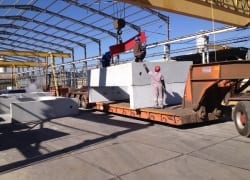
What is being billed as South Africa’s biggest single concrete-culvert order to date is being undertaken at Glencore’s Tweefontein Optimisation Project near Witbank, Mpumalanga.
A total of 800 giant precast concrete culverts, 3.5m-high and just over 5m-wide, and believed to be among the biggest in South Africa to date, are being deployed in the construction of two buffer (stockpile) tunnels. The culverts are comprised of solid steel-reinforced concrete and are designed to handle well in excess of the maximum 20t loading they are likely to encounter at Tweefontein.Each culvert contains 600kg of reinforced steel. The walls are tapered, with a maximum thickness of 350mm at the top end, narrowing to 300mm at the base of each foot.
Manufactured by Concrete Manufacturers Association (CMA) member Aveng Manufacturing Infraset, and designed by the company’s technical marketing manager Coenraad Groenewald, the culverts weigh 12.8t each. They are being produced at Aveng Manufacturing Infraset’s Brakpan manufacturing facility.
International consulting engineers DRA Mineral Projects is responsible for the engineering, project management and construction work on the entire venture.
DRA also designed the coal-handling system in collaboration with civil and structural consulting engineers Holley and Associates. Wilson Bailey Holmes was the main civil and earthworks subcontractor.
This is the first time that DRA has used precast concrete culverts for coal stockpiling tunnels. Steel and on-site concrete were also considered. However, DRA project engineer Arthur Oosthuizen said recent durability and maintenance concerns with steel tunnels and time constraints with on-site concrete construction prompted the decision to opt for precast concrete.
“Although the precast concrete approach is as yet untested in this type of application, we believe it will become our default choice on future projects,” said Oosthuizen.
Initially the requirement was for a height of 4.7m, but this would have rendered the culverts too large for transportation by road. To make up the required elevation, the foundations have been built with raised uprights measuring 500mm.
Given their non-standard dimensions, six custom-made steel moulds are being used for casting the culverts, which is done horizontally. The moulds were designed and supplied by local steel fabricator Mario Meano Engineering.
Seven 200 x 200mm steel utility plates are cast into the inner walls of each culvert to be used as attachment points for electrical cabling and other types of conduit. Once cured, the culverts are loaded horizontally onto low-bed trucks, each bearing two culverts.
The simple and safe handling of the culverts also required some additional engineering. Special steel lifting beams were designed by Groenewald. Rather than using custom-made machinery to turn the culverts upright, Groenewald adopted an innovative approach by using gravity.
This is done by attaching a steel beam to the top end of the culvert, and then by simply lifting this end with a crane, the culvert gains a vertical elevation. The crane then swings the culvert into position so that it comes to rest on the foundation.
“We are under a severe time constraint, and are currently working a double shift, which means at maximum output we can produce 12 units a day. We are also working on Saturdays to ensure that the culverts are delivered on time,” said Groenewald.

