


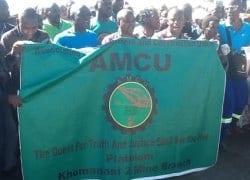
About 80 000 mineworkers have downed tools in the platinum sector, in response to AMCU’s call to strike for a ‘living wage’ of R12 500.
When comparing this internationally, one has to bear in mind that South Africa has the biggest gap between rich and poor in the world.
Its Gini coefficient of 63.1 is higher than any other country, according to the World Bank’s last measure in 2009.
The Gini coefficient, or the Gini index or Gini ratio, is a measure of statistical dispersion intended to represent the income distribution of a nation’s residents, developed by Italian statistician and sociologist Corrado Gini
A Gini coefficient of one (or 100%) expresses maximal inequality among values – for example, where only one person has all the income.
The ANC’s Election Manifesto proposes a national minimum wage of R4 000, significantly lower than the $1 150 demanded by AMCU. An 19-year old worker or apprentice in South Africa earns R7 004.20 a month, according to Doing Business.
In terms of minimum-wage data for the top ten and bottom ten employment-regulating countries, Norway is, predictably, top of the heap at $4 400.06, followed surprisingly by Iran at $4 500 and Luxembourg at $2 280. Japan’s minimum wage is $1 833 and Canada’s is $1 735. South Africa competes, as an ‘emerging market’, with a minimum wage for an apprentice of $646.43.
Other emerging markets fall far short, with India, Ghana and the Central African Republic having minimum wages of about $27. Compared with other African countries, South Africa pays the highest wages to first-time entrants. Its nearest competitor is the Seychelles at $330.76.
South Africa also lags resource exporters. Oil-rich Norway outperforms at $4 400.06. Australia’s minimum wage is about $2 100 and the US is about $1 250. South Africa beats Brazil at $441.97, Russia (about $300), Peru ($268.79 and China ($242.42).
In South Africa, entry-level mineworkers also stand to receive above-wage benefits such as medical aid and housing benefits, annual leave and bonus.
According to the Chamber of Mines, a cost-to-company, entry-level wage of R10 261 breaks down as follows:
- basic salary R5 000;
- provident fund benefit R748;
- medical aid benefit R792;
- housing benefit R1 640;
- leave allowance R417;
- average overtime R951;
- and an average bonus of R715.
A Category 4 entry-level worker’s salary can range between R8 800 and R11 000 (including benefits). Cash and other non-cash benefits increase underground workers’ salaries up to global averages. Skilled artisans can earn a net salary of R30 000, including non-cash benefits.

