


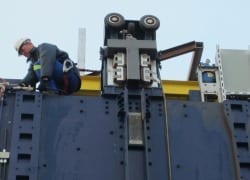
A mine safety system developed and manufactured in South Africa is being commissioned at a large copper mine in Mongolia.
Horne’s emergency fall arresting system (EFAS) is a dual-purpose product that delivers a safe stop to a mine cage in free fall, while additionally delivering the standard chairing function needed at mineshaft stations.
EFAS is a radical departure from safety dogs and other devices traditionally used to arrest mine cages under emergency conditions.
It represents a world first that offers mines the advantage of controlled cage deceleration, and works equally well on both wooden and steel shaft guides.
Safety dogs do not offer controlled deceleration and can only be installed in mines with wooden guides.
At the Mongolian copper mine, Horne engineers have been on site at Number One shaft since early January, testing and calibrating EFAS to ensure that commissioning proceeds on schedule for completion by 14 February, by when the mine must be ready for the Mongolian mining inspectorate.
Commercial production at the mine will begin immediately afterwards.
Guduza System Technologies is also on-site at the mine, working alongside Horne as the South African company responsible for EFAS communications with the winder room.
This communications line must effectively circumvent the accidental earthing to which a mining installation is prone because of damp.
Other cage safety systems have a reputation for accidental earthing and the transmission of false signals that trip the system.
Safety dog communication systems, in particular, have caused transient signals and tripping on so many occasions that many mines have disabled them, electing to use manual communications instead.
To prevent transients in Mongolia, where ambient temperatures can drop to minus 30 deg Celsius, EFAS has been fitted with special PC boards, and special oils have been used in the system power pack and on all lubrication points.
Horne general manager Rob Allman said the possibility of transient signals on EFAS has been completely eliminated.
“We have experienced no problems at all during commissioning,” he said.

