


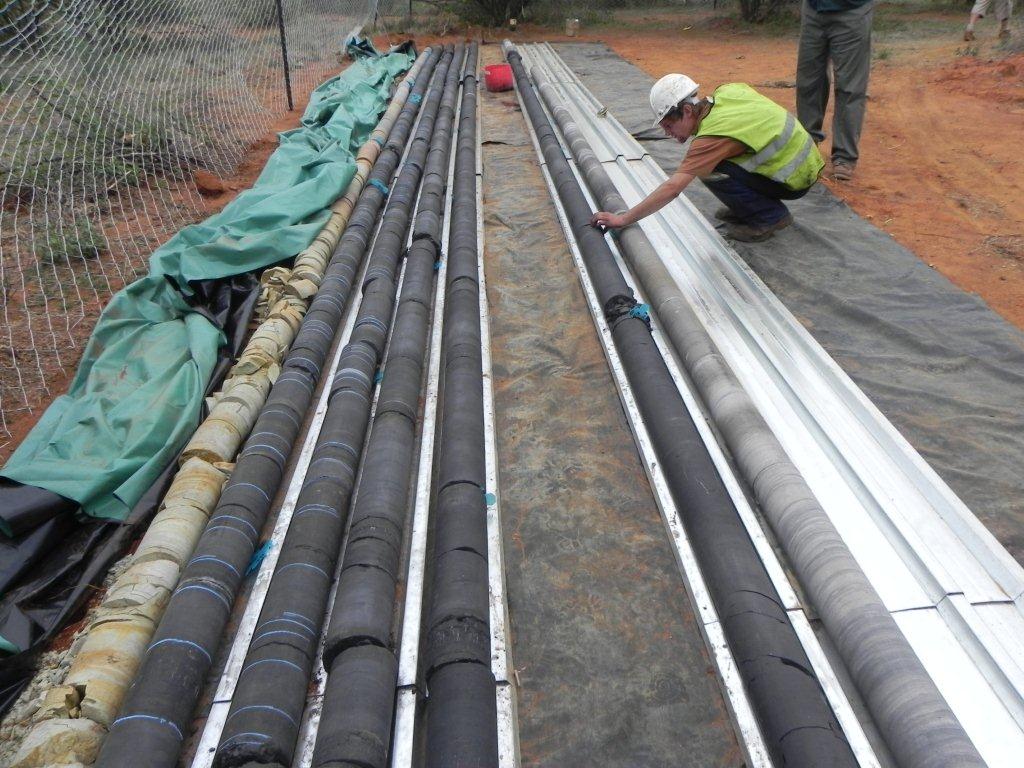
Exxaro’s Grootegeluk mine may be the only coal mine successfully operating in the Waterberg coal fields, but not for much longer. A large-scale, new-generation project is on track to start producing from the region from the beginning of 2015, writes Laura Cornish.
Paving the road to construction start-up The lack of logistics infrastructure remains the primary factor influencing the speed (or lack thereof) at which coal mines develop within the Limpopo-based Waterberg coalfield. Yet ASX-listed Resource Generation (ResGen) has taken such challenges in its stride and overcome them. Not only has the coal developer invested the time and cash into developing its massive new Boikarabelo coal mine in unfamiliar territory, but has also secured all regulatory requirements necessary to raise cash and build its mine – in just four years. Two months ago, the company’s BEE subsidiary Ledjadja Coal, an integrated part of the ResGen management team, signed a ten-year take-or-pay rail haulage contract with Transnet Freight Rail (TFR), allowing the mine to haul up to 6 Mtpa of coal. “This was the last major hurdle we needed to overcome before proceeding to raise project finance and, ultimately, start with construction of the mine and necessary infrastructure,” explains ResGen MD, Paul Jury. “Our agreement with TFR is a significant step towards opening up the Waterberg region.” . Since the TFR announcement, ResGen has been talking to numerous banking institutions, both local and abroad, which are under way with detailed project due diligence studies, but are already showing considerable interest in the project. Capital expenditure is calculated to be US$750 million (R6.25 billion). “We need a debt facility to cover about half of this that, once secured, will leave us to source the remaining amount from equity markets. I anticipate having enough cash in hand to start construction by the end of this calendar year, enabling us to move into production early in 2015.” Sidebar here: Production path Lodge mining rights application Yes Coal off-take Yes CESC: 38-year contract Bhushan Steel: 20-year contract Defined transport solutions Yes Designed infrastructure Yes Mining right issued Yes Project funding Under way Commence mine construction Q4, 2012 scheduled Order mine fleet Q4, 2012 Complete mine construction End 2014 Mine fleet delivery Q4, 2014Coal production Q1, 2015
The Boikarabelo mining plan Reserve: 6.4 billion tonnes[CN1] ; probable reserve: 745 Mt Although production start-up is the primary goal, Boikarabelo already has a long-term plan in place – entailing a major expansion. Phase 1 entails an opencast operation and wash plant with a 14 Mtpa run-of-mine (ROM) capacity. From this it will deliver 3 Mtpa of coal to the export market and another 3 Mtpa of domestic grade quality to Eskom. This is in line with its TFR capacity allocation agreement. Successful test burn results indicate Boikarabelo coal can be utilised with Eskom, and two Mpumalanga-based power stations have already been identified. “We want to increase our coal output substantially in Phase 2, increase annual capacity to 15 Mtpa, of which half will be allocated for domestic use,” Jury reveals. Development for the Phase 2 expansion is scheduled to commence three or four years after production commences. Jury notes that while ResGen may own one of the most prospective Waterberg properties (over 19 000 ha in total) within the entire coal field, beneficiation remains one of the most challenging project aspects. “Our overburden is small, between 20 and 25 m, and our average coal seam (with nine benches) thickness is 140 m – interspersed with shale layers. Our current reserve of 745 Mt also only accounts for 35% of the total resource area, meaning Boikarabelo’s life-of-mine is well beyond the average 20 or 30 years ultimately. “There is, however, a high degree of variability in the coal, with a high level of ultra-fines, meaning we must ensure the beneficiation process is optimised and best suited for the coal is critical. “Because this element of the project is so important, we have appointed two different South African engineering houses to provide us with two different front-end detailed designs based on different process schools of thought.” Power, water and employment Power supply in the region is extremely limited and, as a result, ResGen has elected to develop its own power station as part of its overall project. “Our intention is to build a 45 MW (three 15 MW units) fluidised bed plant power station. Two comprehensive tenders have been received to construct the plant over a two-year period. “Our integrated water use licence has also been approved – and will see us utilise our own water from our own bore-field. We will not be a massive water consumer, however, as a modern mine, it will be contained within a closed circuit.” Once the mine is operational, ResGen will be responsible for the employment of 750 workers, including those employed at the power station. The company has every intention of fulfilling its target to employ an equal gender mix from surrounding communities such as Lephalale, who it will also train. Experienced mine and human resource managers have already been appointed. Sidebar: The Transnet agreement “We have had to make compromises in order to achieve a signed contract with TFR, in particular agreeing to a condition for the allocation of capacity. We are confident, however, that Ledjadja Coal will be provided with its required allocation because our studies show that sufficient rail capacity for our target production should be available once TFR has completed the minimal upgrade works that are required. We have indicated we are prepared to complete these works for TFR if there is a delay.” The main terms of the contract are as follows:- The initial term is for 10 years, with provision to extend for a further 10 years.
- The contract allows for 4 Mt in the first year, 5 Mt in the second year and 6 Mtpa thereafter. Should Eskom elect to contract directly with TFR (which is Eskom’s intention) for the proposed domestic purchases currently under negotiation, the take-or-pay quantities in the contract will reduce to export tonnage only.
- The contract specifies an indicative tariff for the current year. The actual tariff will be determined annually by negotiation.
- The contract is conditional on Ledjadja Coal completing construction of the 36 km rail link to the existing rail network.
- The contract is also conditional on TFR completing its processes to determine a fair, proportional and equitable allocation of rail capacity to all interested parties from the Waterberg. If these are not completed by 31 December 2012, this condition is automatically waived and the above tonnage allocation becomes firm.

