


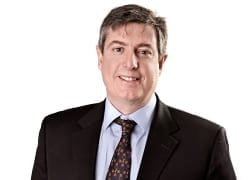
Newly appointed Coal of Africa (CoAL) CEO David Brown talks about the challenge of moving from the platinum to the coal sector, and his turnaround strategy for the company.
Brown has an abiding passion for the mining industry. Having retired from Impala Platinum (Implats) in June 2012, he was looking for his next challenge. “I was evaluating what to do in the next stage of my career,” he tells Inside Mining. “I feel really passionate about mining, and wanted to stay in touch with the industry. During the period leading up to my retirement, I had been having discussions as to what the next phase of my life should look like.” Brown says he had assumed a number of non-executive director roles, from Vodacom to Edcon and Accenture… but mining was still his first choice.
“Then I was presented with this opportunity,” he says simply. Brown was appointed CEO and executive director of CoAL with effect from 1 February 2014. “Quite clearly, CoAL was a company not without its issues and problems, but I saw it as a unique challenge,” he says frankly. “From my point of view it meant I could stay in the mining industry. I had met many colleagues and acquaintances during my time there, and I certainly enjoyed the camaraderie, so I really wanted to remain a part of it.”
Quite clearly it is also an industry faced with its own unique challenges. “The mining industry has been in a very difficult space for the last three to five years.” From the vantage point of his tenure at Implats and now CoAL, Brown reflects: “We find ourselves at a fairly interesting place. I really think it started to go in a different direction when we had the first Eskom crisis in 2008. We had barely recovered from that when we were confronted with the financial crisis and the halving of commodity prices overnight, which had a major impact, and then over the last two to three years we have had prolonged labour unrest and declining productivity.
Pivotal role
“Essentially we are at a turning point now in terms of whether we either go on a high road or not. I think the mining industry can still play a pivotal role in providing large-scale employment, but it needs stability, particularly to encourage investment. Mining is a long-cycle investment. Regrettably I would say that the last five years have been punctuated by uncertainty and policy incoherency in terms of direction, and that certainly has impacted significantly on investment in mining and in this country. Again I think it is hugely disappointing because quite clearly what we need is more investment, so we can create more jobs, in order for the industry to have a positive impact on all stakeholders and communities.”
Brown adds that the current challenges facing the platinum sector in particular have ramifications for the entire industry. “Quite clearly the current labour dispute between the major platinum producers and the Association of Mineworkers and Construction Union (AMCU) is obviously of concern to the industry in general. I think without a doubt there is a need for us to have a new contract between labour and the companies themselves to ensure their sustainability going forward. Linked to that sustainability is the need to deliver greater value to employees. At the same time, employees have to realise that there has to be a transfer of greater value back to the companies themselves in the form of increased productivity. That challenge is probably still the biggest at the moment. I will not say it is unique to the platinum industry. I think it is fairly common in the mining industry in South Africa at this point in time.”
Brown is excited about the opportunities presented by his new position at CoAL. “For me, the real opportunity is around the fact that the company has access to a fantastic suite of assets.” These assets vary from hard coking coal to thermal coal. The latter is “well oversupplied at this time, with prices being quite weak, so it is not exactly an exciting outlook for the next couple of years. Certainly the metallurgical coal, being a rarer source, is more exciting. I like this rarity, in addition to the fact that CoAL has access to a significant proportion of the hard coking coal resources in the country. From that point of view there is a good upside opportunity for us to work towards realising that value for all shareholders.”
Twofold challenge
Brown sees the challenges as being twofold: “One was taking a company that was in a rather poor state and trying to get it over the many different hurdles and legacy issues.” This process has been ongoing for the last 12 to 15 months, and is expected to be finalised within the next 6 months. “That will be a triumph in itself in terms what we have achieved in a short period. I think we have done most of the right things at this point in time.”
The next challenge is linked to the opportunities, which is “starting the value creation side of the equation.” This focuses on two projects, namely Vele and Makhado. “These are two exciting projects going forward, and two very different projects,” says Brown. Vele is a brownfield expansion, much quicker than a greenfield project, and can therefore be brought to account and into a cash-holding position “a lot quicker than we could with Makahado.” The plant modification costs at Vele, including ramp-up and capital costs, are estimated at about $40 million.
“We had to confirm the quality of the coal at Vele. We did comprehensive testing and additional drilling for about a six-month period. We then got experts in to test the semi-soft coking coal fraction in particular. All that was concluded by August 2013, with a positive view that we could produce a good-quality semi-soft coking coal product from that colliery,” says Brown.
Potential users
“We then had to embark on a process of testing that coal with potential users, one of which was ArcelorMittal South Africa. We kept the colliery open for an additional month while we produced a test sample.” This was concluded in December 2013, with Brown confirming that the steel company is “happy with the quality.” The process going forward involves looking at entering into commercial offtake agreements with potential users of the three different coal products derived from Vele. “We believe there is a reasonably-sized market in close proximity to the colliery where we can deliver coal to those users at a better price than they are currently obtaining.”
Brown confirms that CoAL has approached Eskom for a possible offtake agreement for the unsized thermal coal from Vele. Even considering the fact that we are negotiating with third parties in a weak market, these discussions have progressed to the point where “we have made various presentations to a number of commercial banks to look at the debt-funding part of the project. We will finalise the funding process as soon as possible,” says Brown.
However, “Makhado is the game changer for CoAL,” says Brown. “It would certainly provide the company with a significant resource and production base. In fact, when we combine the production base of both Makahado and Vele, we are targeting to be just under a seven-million-tonne-a-year producer, comprising about 2.3 million tonnes of hard coking coal and then probably another 300 000 tonnes of semi-soft coking coal.”
Regulatory approval process
Makhado has currently embarked on a regulatory approval process. “We are working on our empowerment transaction plan. We have had good discussions with the communities and signed a memorandum of agreement for a 20% stake in the project. We believe we are very close to getting the empowerment side of the equation squared away. That would then allow us to approach the government at provincial and national level in terms of empowerment credentials to look at an application for a new-order mining right. Once a new-order mining right is granted, we would then obviously apply for an integrated water-use licence.” Brown says: “We would look at completing the process this year. That would then put us in a position of looking for a strategic partner, who would certainly have a potential interest in entering into an offtake agreement for the hard coking coal product as well.”
Both Vele and Makhado form part of a comprehensive turnaround strategy that Brown has helped to formulate over the past 15 months. “Our first aim was to provide some financial stability in the short-term by enticing a strategic investor.” This proved successful, with Beijing Haohua Energy injecting $100 m into CoAL for a 23.6% stake. “That was really a life-saving injection at that point in time,” says Brown.
The next step was to assess the company’s cost base. “We had to go through quite a painful but necessary process of reducing head count by about 30% to 40%.” Brown says this also involved slashing “superfluous overheads”, which is expected to result in a 50% to 60% reduction in these particular costs. “The overheads are now appropriate to a company of our size and where we are in terms of our evolution.”
The company then had to take a closer look at its thermal coal or non-core assets. “Both Vele and Mooiplats were making significant losses every month, and quite clearly it was an unsustainable position. Therefore we took the decision in August 2013 to close Mooiplaats and place it on a care-and-maintenance basis. Ahead of Vele being prepped for its plant modification process, we effectively wound down production on that colliery as well, which was completed around October 2013.”

